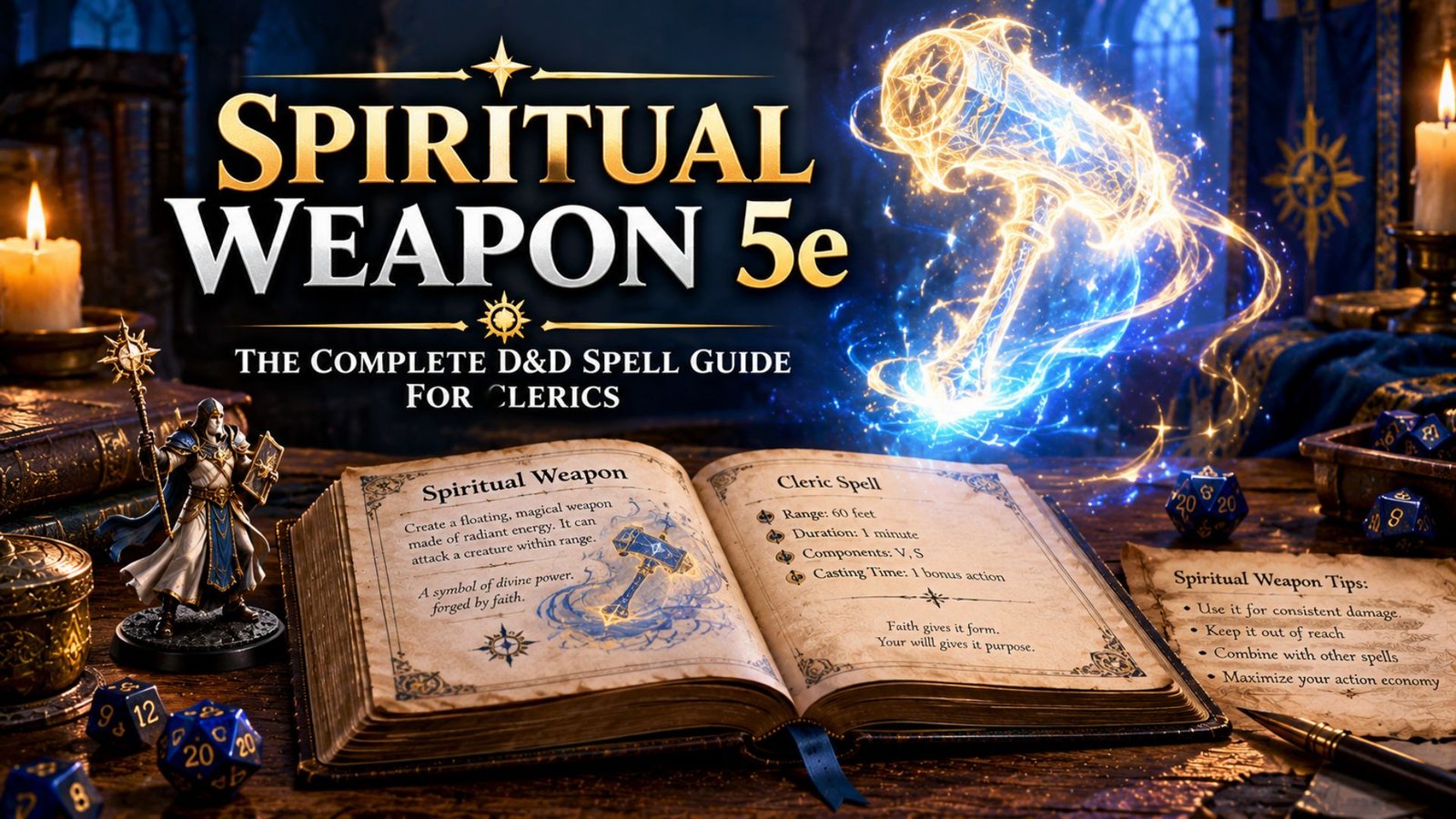
Spiritual Weapon 5e: The Complete D&D Spiritual Weapon Spell Guide for Clerics

Every table has that one cleric. A glowing hammer floats beside the party, and it swings every round. That hammer is the D&D Spiritual Weapon spell. It costs a bonus action. It needs no concentration. It stays useful from level 3 all the way to level 20.
This Spiritual Weapon spell guide explains everything in easy English. You’ll learn the Spiritual Weapon 5e rules, damage math, upcasting, movement, and limits. You’ll also find subclass tips, common mistakes, and roleplaying ideas. Grab your holy symbol and let’s begin.
What Is Spiritual Weapon 5e?
What is Spiritual Weapon 5e? It’s a 2nd-level evocation spell from the Player’s Handbook. Clerics cast it. It ranks among the best cleric spells in Dungeons & Dragons. The spell creates a floating spectral weapon made of magical energy. That weapon hits enemies for you. It also belongs to the proud family of D&D 5th Edition spells that add damage without eating your action. You can read the official wording on D&D Beyond.
Why do players love it? The answer is bonus action economy. Most turns, your bonus action sits unused. This spell puts it to work. Your main action stays free for healing, a cantrip, or a bigger spell. In short, you gain a second attacker without a second character sheet. The table below shows the basics at a glance.
| Feature | Detail |
| Spell level | 2nd |
| School | Evocation |
| Casting time | 1 bonus action |
| Range | 60 feet |
| Components | Verbal, somatic |
| Duration | 1 minute (10 rounds) |
| Concentration | No |
| Damage | 1d8 + spellcasting modifier, force |
| Weapon movement | 20 feet as a bonus action |
| Upcasting | +1d8 per two slot levels above 2nd |
Spiritual Weapon 5e Rules: Casting Time, Range, and Duration
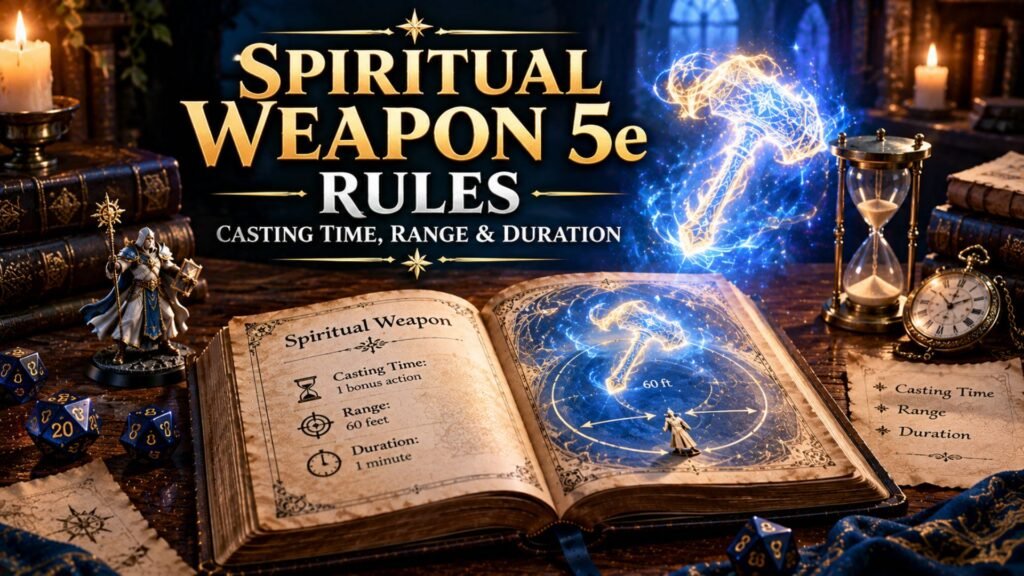
Good rules knowledge wins fights. The core D&D spellcasting rules for this spell are simple. The Spiritual Weapon casting time is one bonus action. The Spiritual Weapon range is 60 feet. The Spiritual Weapon duration is one minute. That equals ten rounds of a typical combat encounter. The spell has no material cost. You only speak and gesture.
These numbers shape your play. The 60-foot reach lets you drop the weapon behind enemy lines. The one-minute timer covers most fights. When time runs out, the weapon fades. It also ends if you cast the spell again. That second casting replaces the first weapon, so you never run two at once.
Can You Cast Spiritual Weapon as a Bonus Action?
Yes. You can cast Spiritual Weapon as a bonus action. That’s the whole appeal. Here’s how Spiritual Weapon works with bonus actions. The casting uses your bonus action for that turn. On later turns you spend it again to command the weapon. Every attack with the weapon needs line of sight to the target and costs a bonus action, because the weapon doesn’t act on its own. One catch exists. If you cast a spell as a bonus action, you can only cast a cantrip with your action that turn. Plan your first round with care.
What Is the Range of Spiritual Weapon 5e?
The range of Spiritual Weapon 5e is 60 feet. That distance controls where you place the weapon when you cast. The spell text doesn’t clearly say the weapon must stay inside 60 feet afterward. Most tables let it roam as long as you can see it and spend a bonus action to command it. Some DMs rule differently. Ask before the session starts.
Does Spiritual Weapon Require Concentration?
Here’s the short answer to does Spiritual Weapon require concentration. No, it doesn’t. That makes Spiritual Weapon without concentration a huge perk. You can hold Bless, Spirit Guardians, or Banishment while the weapon keeps swinging. Taking damage won’t end it. Even a multiclass barbarian can keep it running. Raging barbarians can’t concentrate on spells, but this one isn’t a concentration spell.
Read More About: What Is Spiritual Warfare? Signs, Causes, and How to Stand Strong
How Does the Spiritual Weapon Spell Work in Combat?
How does the Spiritual Weapon spell work? Think of it in three beats. First, you cast it and place the weapon within range. Second, you make a melee spell attack against a creature within 5 feet of the weapon. Third, on later turns you spend a bonus action to move the weapon up to 20 feet and attack again. These Spiritual Weapon attack mechanics sit neatly inside D&D 5e combat mechanics. So can Spiritual Weapon attack on the turn it is cast? Yes. The first strike comes with the casting itself.
How to use Spiritual Weapon in D&D 5e takes only a few steps. Cast it near an enemy. Roll the attack. Next turn, slide the weapon to a new target if you wish. Keep the target in view. The weapon never needs to stand beside you. It fights from wherever you placed it, and your own position matters less. That freedom helps squishy spellcasters stay safe.
Spell Attack Roll and Ability Modifier
Many new players ask, does Spiritual Weapon use Strength or Dexterity? Neither. The Spiritual Weapon spell attack uses your Spiritual Weapon spellcasting ability modifier. For clerics that’s Wisdom. Your attack roll equals a d20 plus proficiency bonus plus Wisdom modifier. Strength and Dexterity don’t matter. A robed cleric with 8 Strength hits as accurately as a plate-clad one.
How Much Damage Does Spiritual Weapon Deal?
How much damage does Spiritual Weapon deal? A hit does 1d8 plus your spellcasting modifier in Spiritual Weapon force damage. Force is a rare damage type to resist. Few monsters shrug it off. With +4 Wisdom, a hit averages 8.5 points. Over ten rounds the Spiritual Weapon damage can reach about 85 if every attack lands. Attack accuracy won’t be perfect, so expect less.
What Weapon Form Can Spiritual Weapon Take?
Here’s the fun part. What weapon form can Spiritual Weapon take? Any form you like. The Spiritual Weapon weapon form is purely cosmetic. A hammer, sword, flail, or glowing quill all work the same. Unless your DM rules otherwise, you always get to choose the form. Pick something that fits your deity.
Spiritual Weapon Upcasting and Damage Scaling
How does Spiritual Weapon damage scale with spell slots? The Spiritual Weapon damage scaling adds 1d8 for every two slot levels above 2nd. What happens when you upcast Spiritual Weapon at 3rd level? Nothing extra. At 4th level you gain one more die. So Spiritual Weapon upcasting only pays off at even slots. The table shows every option across the Spiritual Weapon spell slot levels with a +4 modifier.
| Spell Slot | Dice | Average Dice Damage | Average per Hit (+4) |
| 2nd | 1d8 | 4.5 | 8.5 |
| 3rd | 1d8 | 4.5 | 8.5 |
| 4th | 2d8 | 9 | 13 |
| 5th | 2d8 | 9 | 13 |
| 6th | 3d8 | 13.5 | 17.5 |
| 7th | 3d8 | 13.5 | 17.5 |
| 8th | 4d8 | 18 | 22 |
| 9th | 4d8 | 18 | 22 |
The weapon uses the dice of the slot you spent for every attack. Smart clerics save 4th, 6th, and 8th-level slots for it. Spending a 3rd-level slot wastes resources. You’d do better casting Spirit Guardians there. Remember that bigger slots also compete with other powerful spells. Weigh each choice against the fight ahead.
Spiritual Weapon Movement and Limitations
Spiritual Weapon movement works in simple steps. Your bonus action moves the weapon up to 20 feet. Then it attacks any creature within 5 feet. That gives you a threat reach of about 25 feet from the weapon’s current spot. The weapon floats over rough ground and doesn’t care about terrain. It can also stay put and attack the same target again.
Even so, Spiritual Weapon limitations exist. It needs your bonus action every turn. It needs line of sight. It isn’t a creature, so it can’t grant flanking or advantage effects. It also can’t react to anything. If you fall unconscious, you can’t command it. Learn these edges to avoid unpleasant surprises.
How Far Can a Spiritual Weapon Move?
How far can Spiritual Weapon move? It moves 20 feet each time you spend a bonus action to command it. You can’t save unused movement for later. Each command stands alone. Over several turns the weapon can cross a whole battlefield.
Can Spiritual Weapon Move Through Occupied Spaces?
Can Spiritual Weapon move through occupied spaces? The spell text doesn’t forbid it. The weapon isn’t a creature and isn’t a solid object with stats. Many DMs let it slip past enemies and allies. Others block it like a normal body. Settle this with your DM before the first fight.
Can Spiritual Weapon Be Attacked or Destroyed?
Can Spiritual Weapon be attacked or destroyed? It has no hit points and no armor class. Enemies can’t target it with weapon attacks or ordinary spells. Dispel Magic can end it. Counterspell can stop it during casting. An Antimagic Field suppresses it. Otherwise it lasts until the duration ends or you cast the spell again.
Does Spiritual Weapon Trigger Opportunity Attacks?
Does Spiritual Weapon trigger opportunity attacks? No. Moving the weapon provokes nothing. The weapon can’t make them either. One forum answer sums it up: “The Spiritual Weapon does not get AoO, because it’s not a creature.” So Spiritual Weapon opportunity attacks don’t exist in either direction. Your own movement still follows normal rules.
Is Spiritual Weapon a Real Magical Weapon?
Is Spiritual Weapon a real magical weapon? No. It’s a spell effect that looks like a weapon. This magical weapon versus spell effect gap matters in play. The spell asks for a spell attack and not a weapon attack. That means weapon-only features can’t join in. For example, Divine Smite needs a melee weapon attack, so it can’t ride on a Spiritual Weapon hit. The same logic blocks most other weapon properties.
Official Sage Advice Spiritual Weapon guidance stays light. Most answers come from the spell text itself. That makes DM talks important. On the bright side, the spell effect can’t be disarmed, stolen, or broken like a real sword. It also can’t carry a poison or an enchantment. Treat it as pure magical energy with a pretty face.
Can You Cast Another Spell While Using a Spiritual Weapon?
Can you cast another spell while using Spiritual Weapon? Yes, with limits. The spell isn’t a concentration spell, so you may concentrate on something else at the same time. On the turn you cast it, your action only allows a cantrip. On later turns your bonus action goes to the weapon. You can still cast any leveled spell that uses an action.
A sample sequence shows the rhythm. On turn one, cast Spiritual Weapon and then Toll the Dead. On turn two, cast Spirit Guardians and move the weapon. On turn three, heal an ally and attack again. The only clash comes from other bonus action spells like Healing Word. Choose which one matters more that round.
Spirit Guardians and Spiritual Weapon: Cleric Combat Strategy
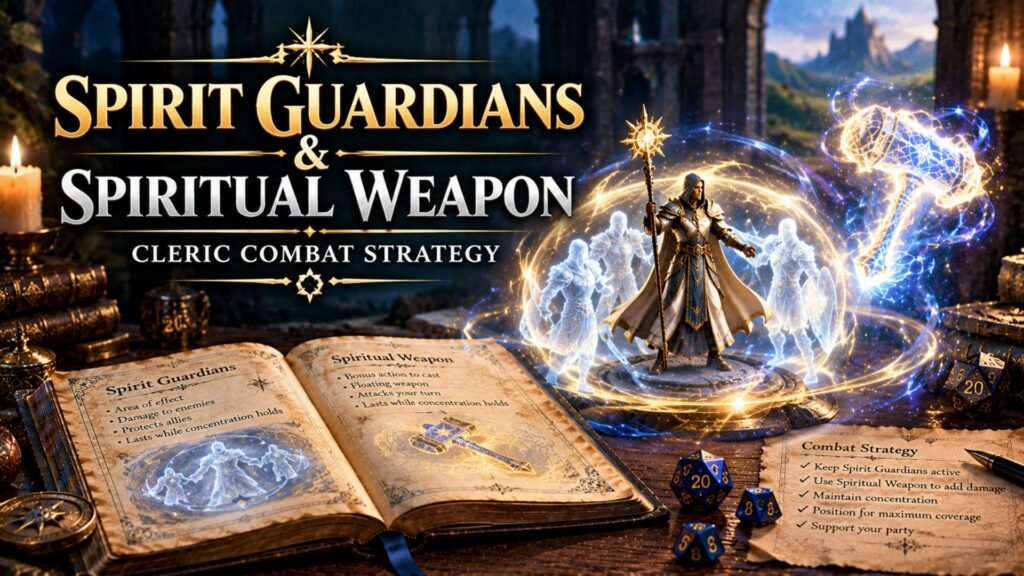
How to combine Spiritual Weapon with Spirit Guardians is a favorite puzzle. Spirit Guardians is a 3rd-level concentration spell. It creates a 15-foot aura that deals 3d8 damage and slows enemies. Spiritual Weapon needs no concentration. So Spirit Guardians and Spiritual Weapon stack without conflict. One uses your action. The other uses your bonus action. Together they form a classic cleric combat strategy.
Good tactical positioning boosts the spell synergy. Let the aura grind down melee foes near you. Send the weapon after archers and spellcasters outside the aura. That way both damage sources hit different targets. Enemies can’t solve both problems at once. This pairing gives strong combat efficiency at almost no extra cost.
Which Cleric Subclasses Benefit From Spiritual Weapon?
Which cleric subclasses benefit from Spiritual Weapon? Every cleric can cast it. Some gain extra value. The three classic picks are the War Domain Cleric, the Death Domain Cleric, and the Tempest Domain Cleric. The Forge Domain also fits, since its armor and defenses keep you alive while the weapon works. These D&D cleric builds thrive on high Wisdom and steady spell use.
A cleric/paladin multiclass looks tempting. It isn’t ideal here. As covered earlier, Divine Smite doesn’t work with the spell. Paladin features also compete for the same bonus action. The table below sums up the main subclass perks.
| Subclass | Key Feature | Why It Helps |
| War Domain | Guided Strike (Channel Divinity) | Adds +10 to a missed attack roll |
| Death Domain | Touch of Death | Adds necrotic damage to a melee attack |
| Tempest Domain | Wrath of the Storm | Punishes attackers while the weapon pressures targets |
| Forge Domain | Blessing of the Forge | Boosts gear and survivability |
War Domain Cleric
The War Domain Cleric gets Guided Strike through Channel Divinity. It adds +10 to an attack roll after you see the d20. That can rescue a missed spell attack. War Priest gives a bonus action weapon attack. It competes with the weapon for that same bonus action. Pick one per turn.
Death Domain Cleric
The Death Domain Cleric brings Touch of Death, which adds necrotic damage when you hit with a melee attack. The Spiritual Weapon strike is a melee spell attack. Many DMs allow the combo. Others read “weapon” more strictly. Check the exact wording at your table.
Tempest Domain Cleric
The Tempest Domain Cleric wears heavy armor and holds the front line. Wrath of the Storm punishes enemies that hit you. Spiritual Weapon adds a second damage source behind the scenes. Destructive Wrath boosts thunder and lightning, not force. So the two damage lines stay separate.
What Are the Strengths and Weaknesses of Spiritual Weapon?
What are the strengths and weaknesses of Spiritual Weapon? The big strengths are free action economy, no concentration, and reliable force damage. It also scales well and fits any deity. The weaknesses include the bonus action cost and the need for line of sight. Dispel Magic can end it too. Overall, the Spiritual Weapon strengths and weaknesses lean heavily toward strength.
Use the table as a cheat sheet. Compare it to other options like Hold Person or Bless. Spiritual Weapon rarely wins on raw power alone. It wins on convenience. Few spells give this much damage for this little effort.
| Strengths | Weaknesses |
| No concentration needed | Uses your bonus action every turn |
| Free attack on the casting turn | Needs line of sight to command |
| Force damage rarely resisted | Ends if Dispel Magic hits it |
| Scales with higher slots | Can’t flank or take reactions |
| Any weapon form you like | Weak at low accuracy without buffs |
How to Maximize Spiritual Weapon Damage
How to maximize Spiritual Weapon damage starts with the basics. Cast it early in the fight. The first hit comes free. Raise your Wisdom. Use even-numbered slots at higher levels. Add Bless to improve attack accuracy. Use Guided Strike if your subclass has it. Keep the weapon beside your best target so you never waste movement.
Spiritual Weapon tactical uses go beyond plain damage. Send it after spellcasters behind the front line. Park it near a hidden enemy you can see. Use it to reach flying foes within its movement, if your DM allows. Chip at a boss while the party handles minions. Treat it as a flexible tool and not a simple damage pipe.
Read More About: What Is the Spiritual Meaning of St. Patrick’s Day?
What Are the Common Mistakes When Using Spiritual Weapon 5e?
What are the common mistakes when using Spiritual Weapon 5e? Players often forget that each attack costs a bonus action. Others try to cast Healing Word and Spiritual Weapon in one turn. Some try Divine Smite on it. A few expect opportunity attacks. Others upcast to 3rd level and gain nothing. Each slip wastes value.
The table lists fixes for the top errors. Print it and tape it inside your character folder. A little care turns this spell into a table favorite.
| Mistake | Fix |
| Treating it as a concentration spell | Keep it running with other concentration spells |
| Casting another bonus action spell | Pick one bonus action per turn |
| Upcasting to 3rd level | Wait for 4th, 6th, or 8th |
| Using Strength or Dexterity | Use your spellcasting modifier |
| Expecting opportunity attacks | None exist for this spell |
| Forgetting line of sight | Keep the target in view |
Spiritual Weapon Roleplaying: Making It Feel Divine
Spiritual Weapon roleplaying adds flavor to every round. A war god’s follower might summon a thundering hammer. A healer might call a soft mace of light. A trickster’s priest could conjure a floating dagger. Show your deity in the shape and the glow. Describe the sound as it swings. Your table will remember the image far longer than the number.
Here’s a quick case study. A level 5 cleric named Brother Anselm serves a god of travelers. He shapes the weapon into a glowing lantern staff. At the start of each fight he lifts his holy symbol and the staff appears. With +4 Wisdom he deals about 8.5 per hit. The group now links the lantern with safe roads. Small details like that build memorable characters.
Frequently Asked Questions
What are the 7 signs of a spiritual awakening?
Common signs include heightened intuition, a deep sense of connection to others and nature, and a shift in values away from materialism. You may also notice increased sensitivity, a search for meaning, changes in relationships, and moments of inner peace or stillness.
What happens during a spiritual awakening?
You begin to question your beliefs, identity, and purpose, often shifting from ego-driven living to greater self-awareness. This can bring emotional release, changes in habits and relationships, and a stronger sense of inner peace and connection.
What are the 12 spiritual powers?
This comes from the Brahma Kumaris tradition, which names 12 inner powers such as the power to withdraw, pack up, tolerate, and accommodate, along with discerning, judging, cooperating, and facing. Others include the power to merge, discriminate, and others that help one stay calm and steady in daily life.
What are the 12 signs of a spiritual awakening?
These expand on the core signs and include a longing for solitude, loss of interest in old habits, heightened empathy, and synchronicities. You may also experience emotional ups and downs, a feeling of being “different,” detachment from outcomes, and a growing desire to serve others.
Conclusion
The Spiritual Weapon 5e spell remains one of the most reliable tools in the cleric toolbox. It’s cheap, flexible, and strong at every level. You now know the rules, the damage scaling, the movement limits, and the best combos. You also know the mistakes to avoid.
Try it at your next session. Cast it early. Pair it with Spirit Guardians. Pick a weapon form that suits your deity. Ask your DM about edge cases before the fight starts. Then watch your glowing weapon do the heavy lifting.