Gorgeous Biblical Meaning of the Name Alice: Spiritual Meaning, Symbolism & Significance

Names carry weight. Parents choose them with care, and people spend years wondering what their own name might say about them. If you’ve landed here searching for the biblical meaning of the name Alice, you’re not alone. This name doesn’t sit inside the pages of Scripture, yet its meaning connects to some deeply biblical ideas about character, identity, and faith.
This article walks through the Alice name’s meaning and origin, its spiritual significance, and how the name lines up with biblical values cherished throughout Christian history. Whether you’re named Alice, know someone who is, or you’re simply curious, you’ll find real depth here. Let’s dig in.
What Does the Name Alice Mean?
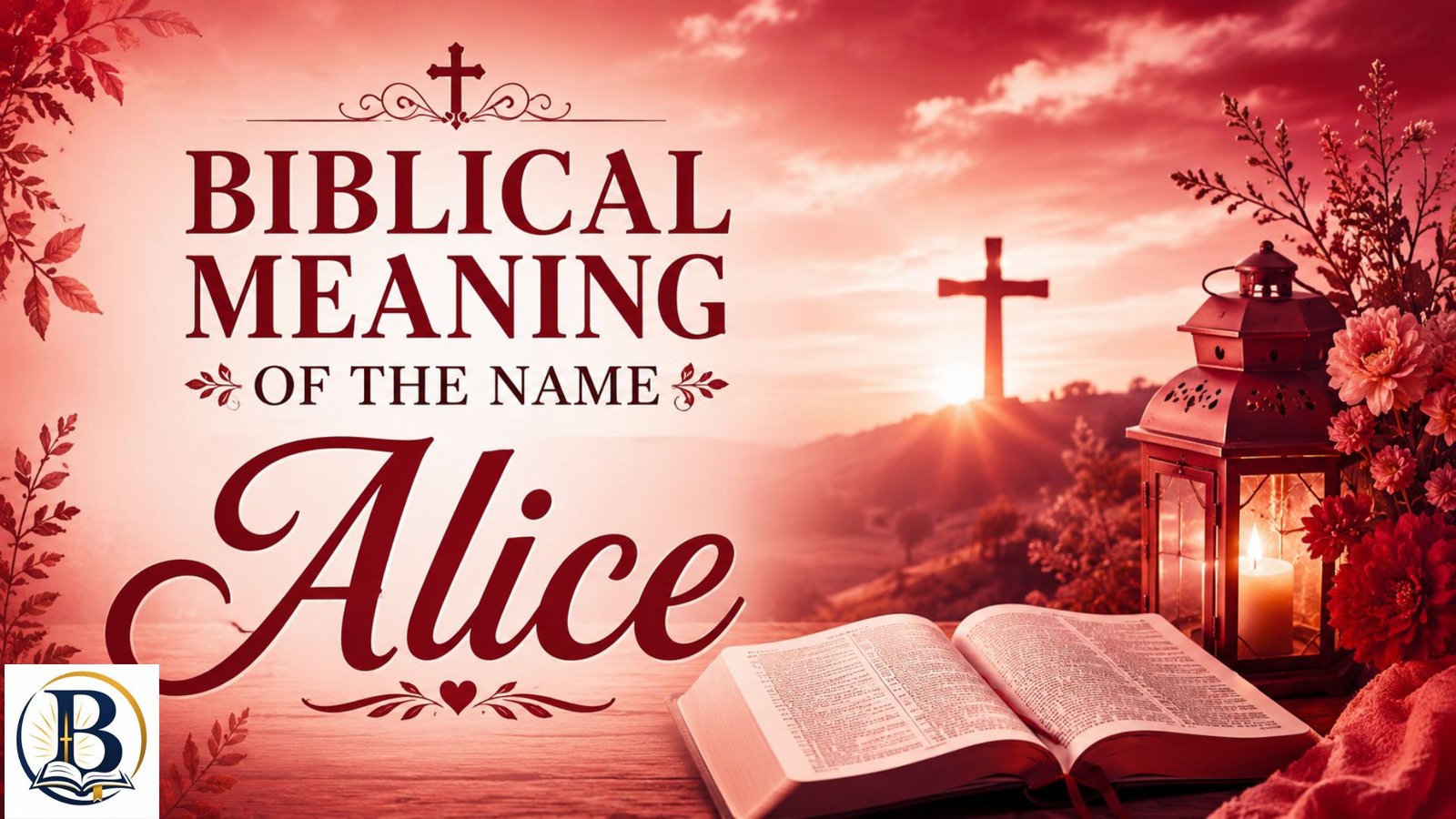
The Biblical Meaning of the Name Alice traces back centuries, long before it became a familiar name across the United States. At its core, Alice means “noble” or “noble kind.” That single word carries a surprising amount of weight once you look at the Biblical Meaning of the Name Alice through a biblical lens.
Understanding the Alice name meaning and origin helps explain why so many people feel drawn to it. It isn’t just a pretty name. The Biblical Meaning of the Name Alice is built on a foundation of dignity, strength, and honor, qualities the Bible speaks about often, even without ever mentioning “Alice” by name.
The Origin and Meaning of Alice
The origin of Alice begins with the Old French name Aalis, a shortened form used in medieval France. Aalis itself grew out of the Germanic name Adalheidis, a name built from two root words. Adal means “noble,” and Heid means “kind” or “type.” Put together, Adalheidis means “of noble kind” or, more poetically, “noble kind.”
Over time, Adalheidis shifted shape across languages. In German, it became Adelheit. In French, it softened into Alix and eventually Aalis. English speakers later smoothed it into the Alice we know today. Think of it like a family tree of names, all branching from the same noble root, each culture giving it a slightly different accent.
Some sources also connect the meaning to “exalted,” which fits naturally with “noble.” Both words point to something lifted up, set apart, or held in high regard. That idea of being set apart shows up again and again once you start reading the Bible through this lens.
The Meaning of Alice and Its Connection to Nobility
Alice and nobility go hand in hand, but here’s the key thing to understand: biblical nobility has almost nothing to do with wealth, status, or bloodline. It’s about character over status. Scripture consistently teaches that true honor grows from a heart devoted to righteousness and obedience, not from a crown or a title.
This is where the meaning of Alice becomes genuinely interesting. A name meaning “noble” doesn’t point toward palaces and thrones in a biblical sense. It points toward noble character, the kind built through faithful devotion, humility, and love. That distinction matters, and it shapes everything else in this article.
Historical Use and Popularity of the Name Alice
Alice became widely used across medieval Europe, and it especially took off in England after the Norman Conquest in 1066. As Norman French blended with English culture, names like Alice traveled with it. Queens, princesses, and noblewomen carried the name throughout the centuries, cementing its association with dignity and grace.
The name has stayed remarkably steady in popularity ever since. In the United States, Alice has moved in and out of the top baby name charts for well over a century, according to Social Security Administration records (ssa.gov/oact/babynames). Few names manage that kind of staying power. It says something about how timeless the meaning behind Alice really is.
| Name Variant | Language | Approximate Meaning |
| Adalheidis | Germanic | Noble kind |
| Adelheit | German | Noble kind |
| Aalis | Old French | Noble |
| Alix | French | Noble |
| Alice | English | Noble, of noble kind |
Is Alice a Biblical Name?
This is probably the exact question that brought you here, so let’s answer it plainly. No, Alice does not appear anywhere in Scripture. But that’s not the end of the story, and honestly, it’s where things get more interesting.
Is Alice a biblical name in the strictest sense? No. But its meaning connects so closely to biblical themes that many Christians still consider it a name rich with spiritual significance. Understanding why requires a little more digging into how names, meanings, and Scripture actually relate to one another.
Does Alice Appear in the Bible?
To be direct: no biblical figure was ever named Alice. The name simply didn’t exist yet during the time the Bible was written. It emerged centuries later through Germanic and French language development, long after the biblical texts were completed.
That said, plenty of names people love today aren’t found in Scripture either, and that hasn’t stopped them from carrying deep Christian meaning. Names like “Grace” or “Hope” work similarly. They’re concepts rooted in biblical values, not names lifted directly from a Bible verse. Alice fits into that same category through its meaning rather than its spelling.
Understanding Alice Through a Biblical Perspective
Even without a direct mention, Alice can be understood through a biblical perspective by focusing on what the name actually means: noble. Philippians 4:8 encourages believers to fix their thoughts on whatever is true, honorable, just, pure, and lovely. That word “honorable” sits right next to “noble” in most translations.
This is how the Christian meaning of Alice takes shape. It’s not about tracing a name through genealogies. It’s about recognizing that the values behind the name, dignity, honor, integrity, already sit at the center of Christian life. The name becomes a quiet reminder of a much bigger biblical idea.
Hebrew Words and Concepts Related to Alice
Here’s an important point of accuracy: Alice has no direct Hebrew origin. Its roots are entirely Germanic and Old French, not Hebrew. Anyone claiming a literal Hebrew translation for Alice isn’t telling the full story.
However, there is a meaningful thematic connection worth exploring. The Hebrew word chayil (חַיִל) appears throughout the Old Testament and carries meanings like strength, virtue, noble strength, and excellence of character. It’s the very word used to describe the woman in Proverbs 31, often translated as “a woman of noble character” or “a virtuous woman.” While Alice doesn’t come from chayil linguistically, the two share the same spiritual thread: strength expressed through godly character rather than status. This Alice Hebrew connection is conceptual, not etymological, and it’s worth being upfront about that distinction.
Read More About: The Astonishing Biblical Meaning of the Name Mason: Spiritual Meaning, Symbolism & Biblical Significance
The Spiritual Meaning of the Name Alice
The spiritual meaning of Alice stretches beyond dictionary definitions. Once you sit with the idea of “noble kind,” you start to see how it maps onto real, lived-out faith. It becomes less about a name and more about a way of living.
Three themes rise to the surface when you explore the spiritual meaning of the name Alice: godly character, wisdom paired with strength, and a life shaped by grace. Each one deserves its own moment of reflection.
Nobility, Dignity, and Godly Character
Nobility, dignity, and godly character aren’t abstract ideas in Scripture. They show up in real people doing real things. Ruth, for instance, is described in Ruth 3:11 as a woman “of noble character,” the same phrase used elsewhere in Proverbs 31. Her nobility wasn’t about wealth. She was a poor widow. Her nobility showed up in loyalty, humility, and quiet faithfulness.
That’s the pattern biblical nobility always follows. It shows up in small, consistent choices: kindness toward a stranger, honesty when it costs something, patience when it would be easier to walk away. Spiritual dignity isn’t loud. It’s steady.
Wisdom and Strength in the Christian Life
The Proverbs 31 woman is clothed, the text says, in “strength and dignity.” That pairing matters. Strength without dignity can turn harsh. Dignity without strength can turn passive. Together, they describe someone capable and composed at the same time, someone who can handle hard things without losing their grace.
This is where Alice meaning noble takes on real texture. A noble life, biblically speaking, holds wisdom and strength in the same hand. It’s the difference between reacting and responding, between panic and steadiness.
Living With Grace and Faith
Grace and faith hold the whole picture together. Nobility, in the biblical sense, was never meant to be earned through perfect behavior. It flows from God’s grace first, and faith simply responds to it. Romans 12:2 puts it well, urging believers to be transformed by the renewing of their mind rather than conformed to the patterns of the world around them.
Living with grace means giving yourself room to grow, not demanding instant perfection. Faith means trusting that the transformation is happening even on the days it doesn’t feel like it. That, too, is part of what “noble kind” can mean for someone walking out their faith day by day.
Biblical Symbolism Associated With Alice
The biblical symbolism tied to Alice moves from internal meaning into visible living. If the spiritual meaning describes the heart, symbolism describes the hands and feet, the actual doing of faith in daily life.
Alice’s biblical symbolism rests on three pillars: righteous living, faithful strength, and a life that reflects truth back to the world. Each pillar builds on the last.
Noble Character and Righteous Living
Righteousness and obedience aren’t about rule-following for its own sake. Micah 6:8 sums up what God actually asks for: to act justly, love mercy, and walk humbly. That’s a short list, but it’s not an easy one. Justice takes courage. Mercy takes patience. Humility takes real self-awareness.
Noble characters in Scripture almost always show up as this trio in action. It’s less about avoiding wrongdoing and more about actively choosing what’s right, even when nobody’s watching and no one would ever know the difference.
Faithfulness and Spiritual Strength
Faithfulness works like an anchor. It holds steady when circumstances shift underneath it. Christian integrity depends on this kind of steadiness, showing up the same way in private as in public, keeping promises even when they’ve become inconvenient.
Spiritual strength isn’t about never struggling. It’s about staying rooted through the struggle. A tree bends in a storm without snapping because its roots run deep. That’s a fitting picture of what faithfulness looks like when life gets hard.
Reflecting God’s Truth Through Your Life
1 Peter 2:9 describes believers as a “chosen people,” a “royal priesthood,” a “holy nation.” That’s identity language, not performance language. It means your worth was never something you had to earn in the first place.
Living out that identity means letting God’s truth show up in ordinary moments, patience in traffic, kindness to a coworker, honesty in a hard conversation. Alice’s spiritual symbolism ultimately points here: a life that reflects something bigger than itself.
Alice and the Christian Life
Names can become quiet teachers if you let them. The word behind Alice, “noble,” has plenty to say about how faith gets lived out day to day, not just in theory but in the ordinary grind of real life.
This section brings the meaning down to earth. It’s one thing to understand biblical nobility as a concept. It’s another to actually let it shape how you show up for people.
What the Name Alice Can Teach About Faith
Nobility isn’t a trait some people are simply born with while others miss out. It’s practiced. Mark 10:43-44 flips the usual definition of greatness upside down, saying whoever wants to become great must become a servant. That’s the opposite of how most people picture nobility, thrones and crowns rather than towels and basins.
The name Alice, through its meaning, quietly points toward this same reversal. True nobility looks like servant leadership, not command from above. It looks like showing up for people rather than being served by them.
Encouragement for Those Named Alice
If you’re named Alice, or you’re considering it for a child, here’s something worth holding onto: your worth was never dependent on living up to a name’s meaning. You already carry value simply because you’re made in God’s image.
Still, there’s something beautiful about a name that points toward noble purpose. You get to decide what that looks like in your own life, through your own choices, your own kindness, your own courage. The meaning isn’t a burden. It’s an invitation.
How Alice Can Inspire a Life of Purpose
Spiritual maturity doesn’t arrive overnight. It builds slowly, one faithful choice at a time. A name meaning “noble kind” can serve as a small, steady reminder to keep choosing integrity, even in unremarkable moments nobody else will ever notice.
That’s really what living for God looks like day to day. Not grand gestures. Just faithful living, one ordinary Tuesday at a time.
Bible Verses That Reflect the Meaning of Alice

Several verses connect naturally to the themes behind Alice’s meaning. Here’s a quick reference table you can come back to.
| Verse | Reference | Connection to Alice’s Meaning |
| “A wife of noble character who can be found? She is worth far more than rubies.” | Proverbs 31:10 | Direct link to noble character and worth |
| “All the people of my town know that you are a woman of noble character.” | Ruth 3:11 | Ruth noble character shown through loyalty |
| “Whatever is true, whatever is noble… think about such things.” | Philippians 4:8 | Direct use of the word “noble” |
| “Be transformed by the renewing of your mind.” | Romans 12:2 | Character shaped by faith, not the world |
| “Whoever wants to become great among you must be your servant.” | Mark 10:43-44 | Nobility redefined as service |
| “You are a chosen people, a royal priesthood, a holy nation.” | 1 Peter 2:9 | Chosen by God, set apart by God |
You can look up any of these verses in full at biblegateway.com for additional context and translation options.
Is Alice a Good Christian Name?
Yes, Alice makes a genuinely strong Christian baby name, even without appearing in Scripture directly. Its meaning, “noble” or “noble kind,” lines up naturally with values the Bible praises again and again: dignity, honor, strength of character, and faithful living.
Plenty of beloved Christian names work exactly this way. “Grace,” “Hope,” and “Faith” aren’t biblical figures either. They’re concepts drawn from Scripture and turned into names. Alice fits comfortably alongside them, less as a name copied from a Bible page and more as a name that echoes a biblical idea. For a Christian family in the United States considering names today, Alice carries both Christian history and timeless meaning worth passing down.
Read More About: The Awesome Biblical Meaning of the Name Dylan: Spiritual Meaning, Symbolism & Significance
Frequently Asked Questions
What does the name Alice symbolize?
Alice symbolizes nobility and noble character. It points to a person marked by dignity, honor, and quiet strength rather than status or wealth.
What is the spiritual meaning of Alice?
The spiritual meaning of Alice centers on living with grace, humility, and faith. It reflects a heart shaped by godly character and devotion to God.
Is Alice a biblical name?
No, Alice doesn’t appear in the Bible. Its meaning still connects to biblical values like righteousness and noble character.
What is a nickname for Alice?
Common nicknames include Ali, Allie, and Ally. Some also use Elsie or Lissy as softer, affectionate variations.
What Bible verse best fits the name Alice?
Proverbs 31:10, describing a “wife of noble character,” fits especially well. Philippians 4:8, which uses the word “noble” directly, works beautifully too.
Does the name Alice have a meaning in Hebrew?
No. Alice has no Hebrew origin. Its roots are Germanic, through Adalheidis, and Old French, through Aalis. Any Hebrew connection is thematic rather than linguistic.
Conclusion
The biblical meaning of the name Alice ultimately tells a story about character, not Scripture verses with the name printed on the page. From its roots in the Germanic Adalheidis through the Old French Aalis, Alice has always carried the meaning “noble” or “of noble kind.” That meaning finds a natural home inside biblical ideas about dignity, grace, honor, and faithful living.
If your name is Alice, or you’re choosing it for someone you love, let it serve as a quiet, steady reminder. Noble character isn’t about status or a title. It’s built through humility, integrity, and a life devoted to walking closely with God, one faithful day after another.