Theo Meaning in the Bible: Origin, Spiritual Meaning & Biblical Connection

You’ve probably heard the name Theo and wondered if it comes from Scripture. Maybe you’re picking a biblical baby name for your child. Maybe you just heard the name and got curious. Either way, you’re in the right place. This article breaks down the full Theo meaning in the Bible, its Greek origin, and what it means for your faith today.
Names in the Bible carry weight. They’re never random. A name often points to someone’s calling, character, or relationship with God. Theo fits right into that tradition, even though it doesn’t show up as a standalone name in Scripture. Let’s dig into why.
Quick Answer: What Does Theo Mean in the Bible?
Here’s the short version. Theo comes from Theos, the Greek word for God. Theos means God. So Theo means God too, in a rooted, symbolic sense. Theo does not appear directly in the Bible as its own name. But Theo is rooted in biblical language, and it’s deeply connected to Theophilus, a name that does appear in Scripture.
Think of Theo as a seed word. It’s small, but it holds the full weight of its root. Theophilus appears in Luke and Acts, and that connection gives Theo its biblical credibility. The name carries an identity rooted in God, even without a direct verse to point to.
What Does Theo Mean in the Bible?
The Theo Meaning in the Bible starts with language, not folklore. It’s a name built from a sacred root word, and that root shapes everything else about its meaning. Understanding this helps you see why so many Christian families choose it today.
The Full Meaning of Theo
Theo is a shortened form of Theos, and Theos is used in the New Testament hundreds of times. It’s the standard Greek word for “God” throughout the Gospels, the letters of Paul, and Revelation. In modern use, Theo functions as a prefix in many longer names. You’ll find it in Theodore, Theodora, Theodosius, and Theophilus. Each of these names builds on the same divine root, just with different endings attached.
This is where theophoric names come in. A theophoric name is one that includes God’s name inside it. Theophoric names carry God’s name, quite literally, embedded in their structure. Theo-based names belong to this ancient tradition. Ancient parents, both Greek-speaking Jews and early Christians, often built names this way. They wanted their child’s name to reflect a life centered on God from the very start.
Biblical and Spiritual Significance
The spiritual meaning of Theo goes beyond just translation. It points to names connected to God as a broader pattern across Scripture. Abraham means “father of many nations.” Israel means “one who wrestles with God.” Names carried destiny back then. Theo, in this same spirit, suggests an identity rooted in God rather than in worldly status or family lineage.
This matters for anyone considering it as a Christian name. A name like Theo isn’t just pretty-sounding. It carries theological significance every time it’s spoken. Parents who choose it are, often without realizing it, tapping into a naming tradition that stretches back thousands of years.
Read More About: 55 Bible Verses For Us That Everything Happens for a Reason
Is Theo Mentioned in the Bible?
This is the question most people actually want answered. And the honest answer is: not directly, but the connection runs deep.
Why Theo Is Connected to the Bible
Theo is connected to Theophilus, and that’s the clearest bridge between this name and Scripture. Theo itself never stands alone in any biblical text. But its root word, Theos, appears constantly. Every time the New Testament writers spoke of God, they used a word that Theo directly descends from. That’s not a loose connection. That’s a direct linguistic inheritance.
So while you won’t find “Theo” printed in your Bible, you’ll find its DNA on nearly every page. Theos is used in the New Testament so often that scholars consider it one of the most repeated words in the entire text. This gives Theo a kind of quiet, built-in biblical connection, even without a dedicated verse.
The Link Between Theo and Theophilus
Luke wrote both his Gospel and the Book of Acts to a person named Theophilus. Look at Luke 1:3-4:
“With this in mind, since I myself have carefully investigated everything from the beginning, I too decided to write an orderly account for you, most excellent Theophilus, so that you may know the certainty of the things you have been taught.” (NIV)
You can read the full passage on Bible Gateway.
Theophilus means “friend of God” or “loved by God,” depending on how you translate the compound. Scholars debate whether Theophilus was a real Roman official, a wealthy patron funding Luke’s work, or a symbolic name representing every reader who loves God. Whichever it is, the name itself carries the exact same root as Theo. That’s the strongest, clearest biblical connection this name has.
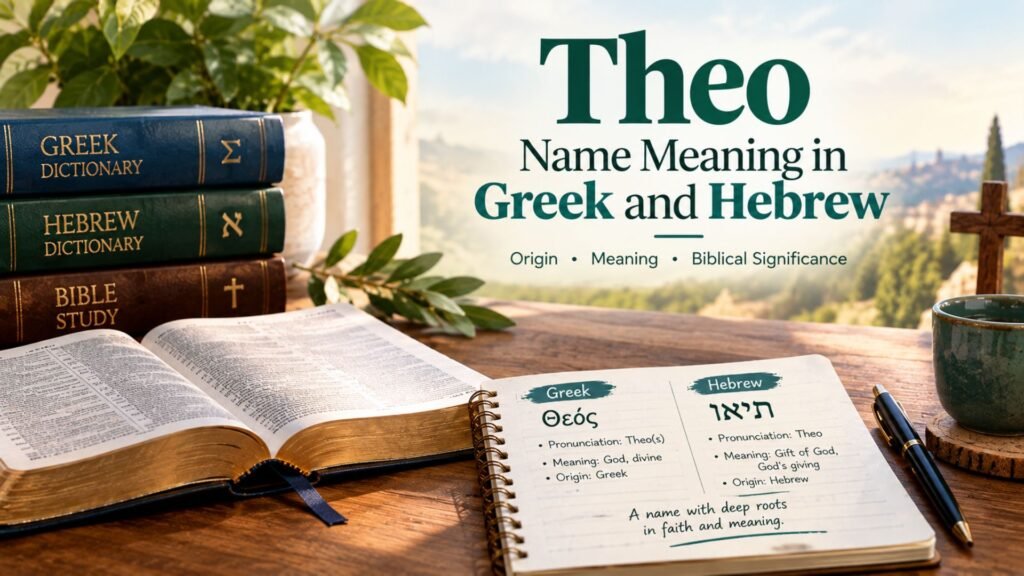
Theo Name Meaning in Greek and Hebrew
Language shapes meaning. To really understand Theo name meaning, you have to look at where the word came from and how it traveled across cultures and centuries.
Greek Origin of Theo
The Greek origin of Theo traces back to Θεός, pronounced “theh-OSS.” This word appears throughout classical Greek literature, long before the New Testament was written. Greek-speaking philosophers used it to describe divine beings in general. But once the New Testament writers picked it up, Theos became specifically tied to the one true God of Israel, revealed through Jesus Christ.
You can see this root everywhere in English today. Theology (the study of God), theocracy (rule by God), and theism (belief in God) all borrow from this same word. So when someone carries the name Theo, they’re carrying a piece of one of history’s most theologically loaded words.
Hebrew Connection
Now, here’s an important clarification. There’s no direct Hebrew connection for the word Theo itself. Hebrew and Greek are different language families, and they don’t share roots the way Greek and Latin sometimes do. But conceptually, the Hebrew connection still matters.
In Hebrew, the words for God include El and Elohim. Just like Theos in Greek, these words describe God’s power, authority, and divine nature. So while Theo has no Hebrew word-origin, it shares a thematic twin in Hebrew Scripture. Both languages, in their own way, gave humanity a word big enough to hold the idea of God.
| Language | Word for God | Meaning |
| Greek | Theos | God, divine being |
| Hebrew | El / Elohim | Mighty one, God |
| English (derived) | Theo- | Prefix meaning “God” |
Bible Verses Connected to the Meaning of Theo
Even though Theo isn’t a named character, plenty of verses reflect the ideas behind its meaning. These verses help you understand what this name is really pointing toward.
Bible Passages About God’s Presence
God’s presence runs through the entire Bible, from Genesis to Revelation. Psalm 139:7-10 says:
“Where can I go from your Spirit? Where can I flee from your presence? If I go up to the heavens, you are there; if I make my bed in the depths, you are there.” (NIV)
You can read more of this psalm on Bible Gateway. Deuteronomy 31:6 adds another layer: “The Lord your God goes with you; he will never leave you nor forsake you.” And Matthew 28:20 closes the New Testament promise with Jesus saying, “I am with you always, to the very end of the age.”
These verses aren’t about Theo directly. But they capture the exact theme this name represents: divine presence, nearness, and closeness to God.
Verses That Reflect the Meaning Behind Theo
Beyond presence, Luke 1:3-4 and Acts 1:1 give us the actual textual anchor for this name family. Acts 1:1 opens with, “In my former book, Theophilus, I wrote about all that Jesus began to do and to teach.” Both verses show a personal, direct address, one friend writing to another about the works of God. That’s the heartbeat of the spiritual meaning of Theo, wrapped in real Scripture.
Spiritual Meaning and Symbolism of Theo

Names do more than identify. They shape how people see themselves. The spiritual symbolism behind Theo touches three major areas of Christian life.
God’s Presence
At its core, Theo symbolizes God’s presence rather than God’s distance. This flips a common misconception people have about faith, that God is far away, watching from a distance. Theo pushes against that. It says God is near, God is present, and involved in everyday life, not just in dramatic moments.
Faith and Trust
The name also reflects faith and trust in God. Someone connected to this name, or drawn to it, often carries a quiet confidence that things are being handled by something bigger than themselves. This isn’t passive faith. It’s active trust, the kind that shows up in daily decisions, not just Sunday mornings.
Living with Divine Purpose
Finally, Theo points toward divine purpose. If Theodore means “gift of God,” and Theo shares that root family, then living out this name means recognizing that your life itself is a gift of God. That shifts how you view your talents, your relationships, and even your struggles. Nothing is wasted when it’s viewed through the lens of divine purpose.
Biblical Interpretation of Seeing the Name Theo in Dreams
Dreams have always held spiritual weight in Scripture. Joseph, Daniel, and even Pilate’s wife all experienced meaningful dreams. So it’s natural to wonder what it means if the name Theo shows up in yours.
Peaceful Dream Meaning
A calm, peaceful dream featuring the name Theo often points toward reassurance. It can feel like a quiet confirmation that God is near, that your prayers are heard, and that your current path aligns with His plan. These dreams tend to show up during seasons of renewed faith, right when you needed a small nudge of comfort.
Warning or Unsettling Dream Meaning
An intense or unsettling dream isn’t necessarily bad news. Instead, treat it as a gentle wake-up call. It might point toward spiritual neglect, unresolved conflict, or a season where prayer and Scripture took a back seat. Rather than fear, respond with reflection. Ask yourself what area of life needs realignment with God’s will.
Practical Faith Lessons from the Meaning of Theo
Meaning means little without application. Here’s how the ideas behind Theo can actually shape daily Christian living.
Lessons for Christian Living
The name teaches a few clear, practical lessons. Seek God daily, not just when life gets hard. Remain faithful even when circumstances feel uncertain. Walk closely with God through ordinary routines like prayer, honest conversation, and quiet reflection. Live with humility, remembering that identity comes from relationship, not achievement. And finally, trust God’s plan, even when you can’t see the full picture yet.
| Lesson | Practical Action |
| Seek God daily | Set aside consistent prayer time |
| Remain faithful | Stay grounded during hard seasons |
| Walk with humility | Give credit to God, not self |
| Trust God’s plan | Release the need for full control |
Why Many Christian Parents Choose Theo
Christian parents choosing Theo often want a name that’s short, strong, and rooted in something real. It’s easy to say, easy to spell, and it carries centuries of church history behind it. According to the Social Security Administration’s baby name data, names like Theo have climbed steadily in popularity across the United States over the past decade. Parents want meaning without complexity, and Theo delivers exactly that.
Common Misconceptions About Theo
A few myths tend to follow this name around. Let’s clear them up directly.
Is Theo a Biblical Character?
No, Theo is not a biblical character on its own. People sometimes confuse it with Theophilus, assuming they’re the same figure. They’re related in root word only, not in identity. Theophilus was a specific person Luke addressed. Theo, as we use it today, is a modern derivative name.
Does Theo Mean “Gift of God”?
Not exactly, and this trips a lot of people up. “Gift of God” is actually the meaning of Theodore, not Theo by itself. Theo simply means “God.” Theodore combines Theos with doron, the Greek word for gift. Over time, Theo became shorthand for Theodore, which is how the “gift of God” meaning got attached to it in casual use.
Is Theo Only a Nickname?
No, not anymore. Theo used to function mainly as a nickname for Theodore or Theodora. Today, especially in the United States, it stands as a full, independent given name. Parents register it on birth certificates directly, without any longer version attached.
Theo in Modern Christian Life
Names evolve. Theo has moved from a background nickname into a front-and-center choice for modern families.
Popularity as a Christian Name
Theo fits neatly alongside other rising biblical names like Eli, Noah, and Asher. These names share a pattern: short, strong, and God-rooted. American parents especially favor names that sound modern but carry ancient weight. Theo checks every box on that list.
Cultural and Faith-Based Usage
Beyond naming trends, Theo shows up across Christian media, church directories, and even in Catholic tradition through its connection to Theodore, a name shared by several saints and popes throughout history. The name carries a quiet dignity that fits comfortably into both casual conversation and formal church settings.
Read More About: 75 Effective Midnight Prayers for My Future Husband
Frequently Asked Questions
What is the full meaning of Theo?
Theo is short for names like Theodore and Theodora, meaning “gift of God.” It comes from Greek roots—theos (God) and doron (gift).
What does Theo mean spiritually?
It carries a sense of divine blessing, as if the child is seen as a gift from a higher power. Many parents choose it for that spiritual weight without needing religious ties.
What is Theo in Hebrew?
Theo itself isn’t Hebrew, but it echoes similar Hebrew names like Matthew or Nathaniel, both mean “gift of God.” The closest Hebrew equivalent would be Netanel or Mattityahu.
What is another name for Theo?
Common alternatives include Theodore, Theodoric, and Theodosius for boys, or Theodora for girls. Some also use it as a nickname for Matthew or Timothy in certain cultures.
Is Theo a good name?
Yes, it’s warm, short, and easy to pronounce across languages. It’s been rising in popularity for its classic-yet-modern feel.
How rare is Theo?
It’s not rare anymore, it’s actually climbing fast in the U.S. and Europe. Still, it feels distinctive since it’s less common than names like Liam or Noah.
Is Theo a biblical name?
Not directly, but it’s closely tied to Theophilus, a name that appears in both Luke and Acts.
Does Theo mean “gift of God”?
That meaning technically belongs to Theodore. Theo on its own simply means “God.”
What does it mean to dream about the name Theo?
It often reflects reassurance of God’s presence, or occasionally, a gentle call to reconnect with your faith.
Is Theo related to Theodore?
Yes, Theo commonly functions as a short form of Theodore, Theodora, and even Theodosius.
What Bible verse is Theo based on?
There’s no direct verse for “Theo,” but Luke 1:3 and Acts 1:1 both address Theophilus, the closest biblical link.
Conclusion
The Theo meaning in the Bible comes down to one simple truth: it means God. Theo comes from Theos, and that single root connects it to an entire family of names, including Theodore, Theodora, and Theophilus. While Theo does not appear directly in the Bible, its connection to Theophilus in Luke and Acts gives it real, textual roots in Scripture.
More than etymology, this name carries a message. It reminds you that identity rooted in God matters more than achievement or status. Whether you’re considering it as a Christian name for your child, or you simply stumbled onto its meaning out of curiosity, Theo points toward the same thing every time: a life centered on God, marked by faith, humility, and quiet trust in His plan.