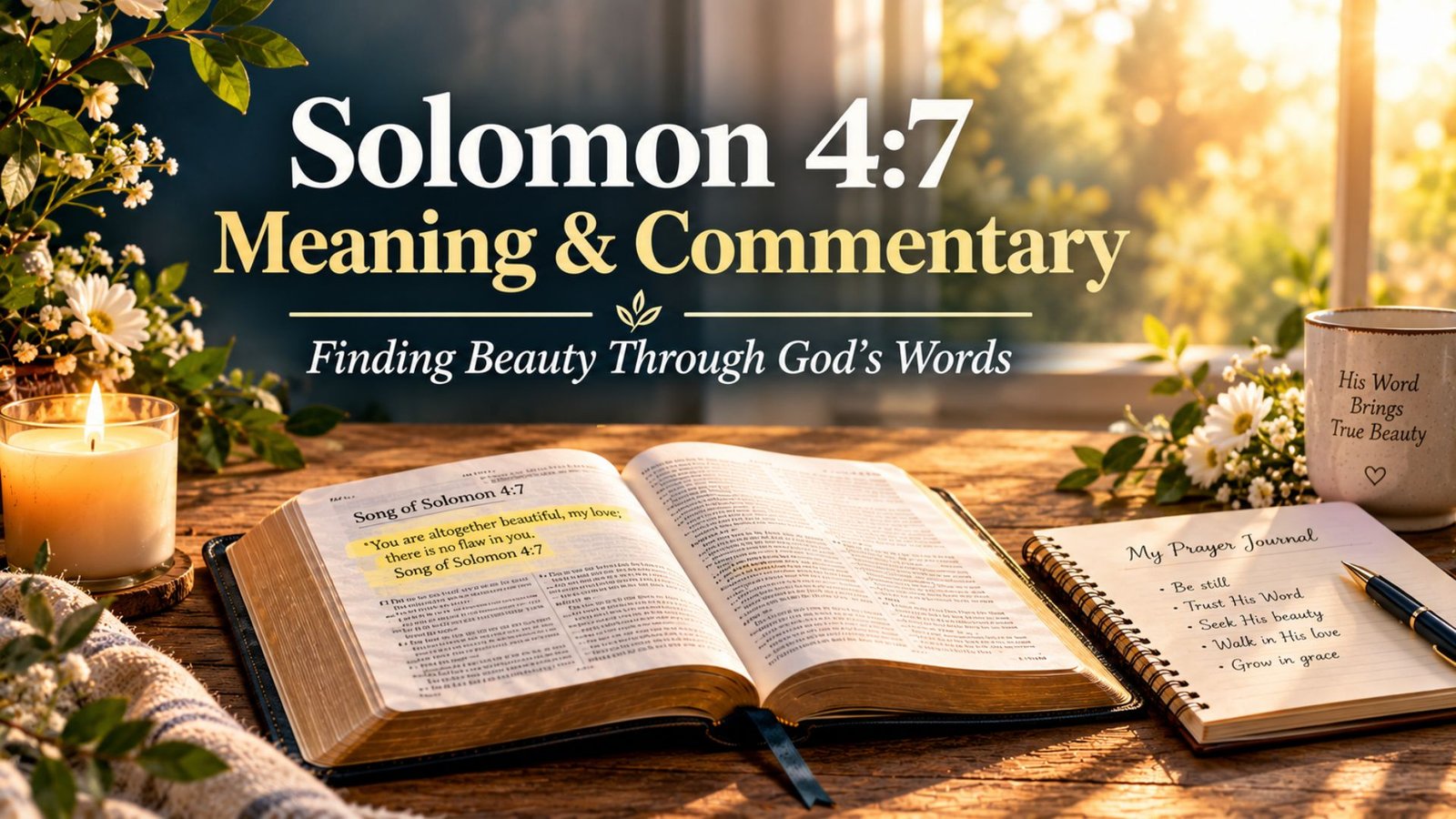
Solomon 4:7 Meaning & Commentary: Finding Beauty Through God’s Words

Have you ever heard someone say “you’re perfect” and quietly think, “If only you knew”? Most of us have. We know our flaws well. We replay our mistakes at night. Then a short verse from the Song of Solomon cuts through all that noise. The Bible verse reads, “You are altogether beautiful, my darling; there is no flaw in you” (NIV). You can read the full passage on Bible Gateway.
This guide explains the Solomon 4:7 meaning in plain words. You will see the poem’s setting, its Hebrew poetry, and its link to God’s grace. You will also find a simple way to use the verse in your own daily devotionals. Along the way you will learn how beauty through God’s eyes can reshape your spiritual identity in Christ.
What Is the Meaning of Solomon 4:7 in the Song of Solomon?
The Solomon 4:7 meaning starts with a love story. The Song of Solomon (also called the Song of Songs) is a book of love poems in the Old Testament. In chapter 4, the bridegroom praises his beloved from head to shoulders. Verse 7 closes that praise. It works like a final sentence at the end of a heartfelt speech. The KJV puts it this way: “Thou art all fair, my love; there is no spot in thee.” Tradition names King Solomon as the author. Scholars still debate that point. The poem’s core message stays clear either way. It celebrates covenant love between two people.
Christians also read the verse on a second level. This is the theological interpretation of the Song of Songs. Jewish readers long saw the couple as God and Israel. Christian readers saw them as Christ and the Church. Here is the key point. The spiritual reading grows out of the literal one and does not replace it. Think of a house with a strong foundation. The love poem is the foundation. The picture of Christ’s redemption is the upper floor built on top. Good Song of Songs commentary respects both.
| Reading | Who Is Speaking? | Main Idea |
| Literal | A groom to his bride | Covenant love and joyful admiration in marriage |
| Spiritual | Christ to the Church | Divine acceptance and grace and redemption |
How Does Solomon 4:7 Describe Beauty and Flawlessness?
The phrase altogether beautiful sums up the whole portrait in verses 1 through 6. The groom is not grading his bride on a scorecard. He is overwhelmed. In the text, his praise focuses mostly on her outward features, such as her eyes, hair, and smile. The idea of inner beauty comes from the wider Bible. Still, the poem shows a love that sees the whole person and delights in her. That is why flawlessness here feels warm and not cold. It describes biblical beauty as something loved and not just measured. When you ask what is biblical beauty, this verse gives a first answer. Beauty in scripture is tied to being known, wanted, and treasured.
Who Is the “Darling” in Solomon 4:7?
In the poem, the darling is the bride. The Hebrew word behind it, from the root ra’yah, carries the sense of a close companion or friend. So the groom calls her more than a pretty face. He calls her his friend. Just a few verses later, in 4:8 through 12, he calls her “bride.” That shift adds depth to the picture. In Christian theology, the bride stands for the redeemed people of God. The bride imagery invites you to see yourself as a cherished companion and not a servant who is barely tolerated. That fits the heart of how God sees believers.
What Is the Spiritual Significance of “No Flaw in You”?
The Hebrew word for flaw is mum. It means a blemish. Priests used it in the sacrificial system. An animal with a mum could not serve as a spotless offering (see Leviticus 22). That background explains why the phrase no flaw in you matters so much. It points to being fit, clean, and acceptable before God. The New Testament uses the same idea. In Ephesians 5:27, Christ presents the church “without stain or wrinkle.” This is the Hebrew symbolism of blemish at work. The theological meaning of flawlessness is not that you never fail. It means Christ’s righteousness covers you, so you stand flawless before God.
Read More About: 66 Powerful Morning Prayers to Cancel Bad Dreams of the Night
What Is the Historical and Cultural Context of Song of Solomon 4:7?
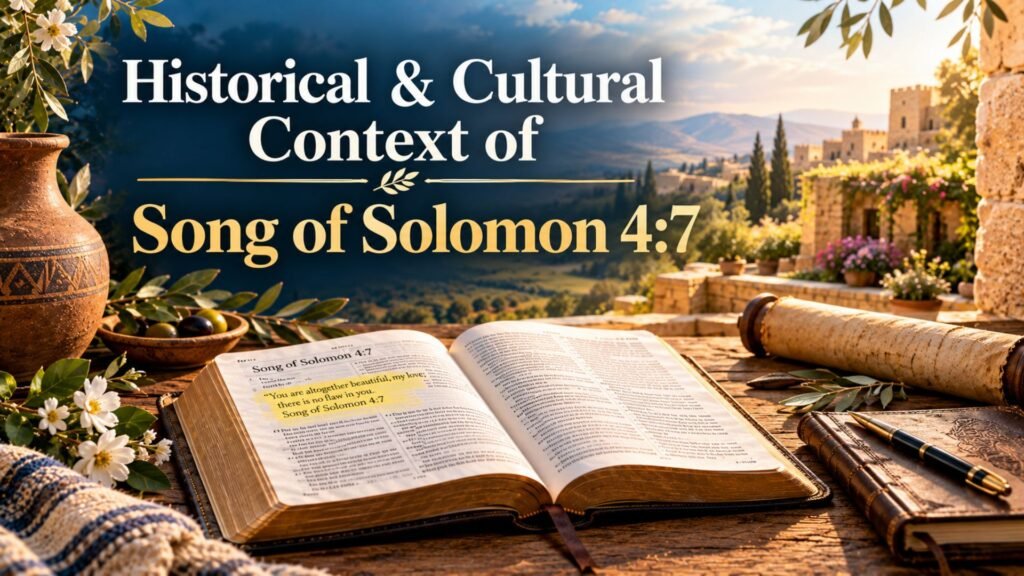
Picture the ancient Near East. Love songs and wedding poems were a respected art form there. People sang them at feasts and gatherings. The Song of Solomon sits among the wisdom writings of ancient Israel. It celebrates love inside marriage as a gift from God. That context protects the book from being misread. It is not a casual romance. It is a picture of covenant relationship and faithful devotion. Reading it this way helps you see why the Bible verse explanation must start with marriage before it moves to the Church and Christ.
The imagery can sound odd today. The groom compares her hair to a flock of goats and her neck to a tower (4:1 through 4). Modern ears may giggle. Yet in a hill-country, farming culture those pictures were high praise. Goats on a green hillside meant life and health. A tower meant strength and grace. Imagine a rancher in Texas saying, “You shine like a new pickup truck at sunrise.” It sounds funny to outsiders. To him it is the best compliment he knows. Poetic imagery always speaks in the language of its own people.
How Did Ancient Israelite Marriage Customs Influence This Bible Verse?
In ancient Israelite marriage customs, marriage was a covenant and not only a feeling. Families joined together. Public celebrations lasted days, and songs praising the bride were part of the joy. So the groom’s words in 4:7 worked like a public promise as well as a sweet compliment. He was saying, “I choose her, and everyone should know it.” That setting gives the verse weight. It also shows why the New Testament later used bridal imagery for Christ and the Church. A faithful bridegroom who publicly honors his bride was a picture people already understood.
What Poetic Devices Are Used in Solomon 4:7?
Hebrew poetry does not rely on rhyme. It relies on balance and picture. Verse 7 uses three clear tools. The first is parallelism. The two halves, “altogether beautiful” and “no flaw,” say one idea from two angles. The second is hyperbole. The word “altogether” stretches the praise to its limit, as love often does. The third is the summary line. Verse 7 gathers all the earlier images into one short sentence. The verse does not use repetition, so that claim should be skipped. Seeing these tools helps your Bible study because the metaphor and poetic imagery become easier to follow.
| Device | Where It Shows | Effect |
| Parallelism | Beautiful / no flaw | Reinforces one idea |
| Hyperbole | “Altogether” | Shows total delight |
| Summary line | Verse 7 after verses 1–6 | Closes the poem with a strong finish |
How Does Solomon 4:7 Reflect God’s Perspective on Beauty and Redemption?
God does not look at people the way a judge reads a record. He looks the way a loving parent does. Picture a child’s messy drawing on the fridge. The lines wobble and the colors clash. Yet the parent hangs it with pride. That is a small picture of God’s perspective on beauty. Through God’s love and God’s mercy, believers are seen as treasured. This idea matches how God sees believers across the Bible. It also answers the question what does Song of Solomon 4:7 mean for everyday life. It means you are loved first and improved second.
A fair note belongs here. Applying this verse to God’s grace is a Christian application and not the original setting. Other passages support the idea clearly. Isaiah 61:10 says God clothes his people with garments of salvation. Colossians 1:22 says believers are presented holy and blameless. These verses give the spiritual beauty theme firm ground. They show that redemption themes in the Bible do not rest on one verse alone.
What Does “All Beautiful, My Darling” Reveal About God’s Grace and Love?
The words all fair, my love show a love that does not wait for perfection. The groom does not say, “You will be beautiful when you improve.” He says, “You are.” That mirrors unmerited grace. Romans 5:8 says Christ died for us while we were still sinners. That is unmerited favor in its purest form. Grace and self-worth go hand in hand here. When you grasp that divine love came first, you stop trying to earn it. You also hear Zephaniah 3:17, where God rejoices over his people with singing. That is divine affirmation you can lean on.
How Is Flawlessness Connected to Christ’s Redemption in the Bible?
Sin leaves a stain. Everyone knows the feeling of guilt that will not wash out. Christ’s redemption deals with that stain at its root. 1 Peter 1:18–19 says believers were redeemed by the blood of Christ, “a lamb without blemish or defect.” That wording echoes the Hebrew word mum. The link is not an accident. Forgiveness removes the spot. Salvation restores spiritual purity. This is how Christ removes spiritual blemishes and why spiritual purity through salvation is a gift and not a prize.
How Does This Verse Relate to the Church as the Bride of Christ?
The church as the bride of Christ is a major New Testament theme. Ephesians 5:25–27 says Christ loved the church and gave himself for her. 2 Corinthians 11:2 speaks of presenting believers as a pure virgin to one husband. Revelation 19:7 describes the wedding of the Lamb. These passages form the church symbolism behind the spotless bride. The Song of Solomon is one place where readers have long seen that theme echoed. The picture stresses devotion, holiness, and covenant love. It invites you to rest in a love that will not walk away.
How Can Believers Find Personal Beauty Through God’s Words in Solomon 4:7?
Scroll through any social media feed and you will feel it. Everyone looks polished. Everyone seems ahead. The comparison trap is real. Finding beauty through God’s words offers a different measuring stick. Scripture meditation replaces the filter with the truth. The Solomon 4:7 meaning reminds you that beauty in scripture begins with being loved. It does not begin with being ranked. A steady habit of reading and praying can slowly retrain your mind. That is spiritual transformation through grace at a human pace.
Here is a simple habit you can try this week. Read the verse slowly. Name one lie you believe about yourself, such as “I’m too far gone.” Then replace it with one truth from the Bible, such as “I am redeemed.” Write both down. Repeat for seven days. This small practice supports overcoming negative self-image through faith. It also builds faith and confidence one day at a time. Spiritual growth through scripture rarely happens in a flash. It happens in small, faithful steps.
How Does Understanding This Bible Verse Impact Self-Worth and Faith?
Self-worth in Christ does not rise and fall with likes or opinions. It rests on what God has said about you. Psalm 139:14 says you are “fearfully and wonderfully made.” That is biblical self-esteem in a few words. It is not pride. It is grace-based identity. When you accept it, grace changes self-perception in quiet ways. You stop hiding. You forgive faster. You serve with more joy. A caring note matters here. This verse supports spiritual healing through grace but does not replace a pastor or counselor if you struggle deeply with self-image.
Case study (a composite example): Think of a woman named Maria who grew up hearing criticism. She worked hard to look perfect at church. She felt tired and unseen. One Sunday she studied Song of Solomon 4:7 in a small group. Over several weeks she wrote a daily prayer using the words “no flaw in you” as a reminder of Christ’s righteousness. Her striving eased. She began to serve from joy instead of fear. Her story is not unusual. Many believers find that living in God’s acceptance changes how they treat themselves and others.
What Are Reflection Questions to Deepen Spiritual Growth?
Good questions open the heart. They turn reading into personal reflection on Bible verses. Ask yourself what you assume God sees when he looks at you. Ask where you chase approval instead of resting in divine acceptance. Ask which part of your story you hide from him, and why. Ask who in your life needs to hear “you are loved” from you this week. Finally, ask how your view of beauty would change if you saw it through God’s eyes. Write your answers in a notebook. Share them with a trusted friend in your fellowship group. Honest talk often brings spiritual renewal faster than silent worry.
Read More About: 66 Midnight Warfare Prayers Against Financial Attacks
How Can Daily Devotionals Incorporate Solomon 4:7?
A five-minute routine is enough. Read the verse aloud. Pray a short thank-you for God’s mercy. Journal one sentence about what stood out. Memorize a few words, such as no spot in thee. Share the thought with someone. This rhythm turns Bible study resources into real life. It also supports daily devotional application without pressure. The table below gives one theme for each day of the week.
| Day | Theme | Short Prayer Focus |
| Monday | Loved first | Thank God for divine love |
| Tuesday | Seen fully | Ask to see yourself through God’s perspective |
| Wednesday | Made clean | Rest in forgiveness |
| Thursday | Clothed in grace | Read Isaiah 61:10 |
| Friday | Part of the bride | Pray for the Church |
| Saturday | Rejoiced over | Read Zephaniah 3:17 |
| Sunday | Worship | Praise Christ for redemption |
What Related Bible Verses Reinforce the Theme of Inner Beauty and God’s Grace?

The Bible says again and again that God looks deeper than appearance. 1 Samuel 16:7 says people look at the outward appearance but the Lord looks at the heart. That single line explains much of the inner beauty according to the Bible. It also shows why Solomon 4:7 should not be read as a beauty contest. The verse speaks of delight. The wider scripture shows what that delight rests on. The Old Testament and New Testament speak with one voice about God’s view of imperfection. He does not ignore it. He covers it with grace.
Reading related passages together gives a fuller picture. Each verse adds a color to the portrait. Read each one in its own chapter so the setting is clear. Notice how righteousness, holiness, and mercy keep appearing. These words form the backbone of redemption and righteousness across the Bible. They also support understanding the Song of Songs in Christian theology as part of a larger story. That redemption story begins in Genesis and ends in Revelation.
Which Scriptures Highlight Spiritual Beauty and Flawlessness?
Several verses sit close to the Solomon 4:7 meaning. 1 Peter 3:3–4 values a gentle and quiet spirit. Proverbs 31:30 says charm fades but fear of the Lord lasts, which fits biblical womanhood at its best. Isaiah 61:10 describes being clothed in righteousness. Colossians 1:22 speaks of being presented holy and blameless. Ephesians 5:27 shows a radiant church. Together they build a clear biblical understanding of beauty.
| Verse | Core Idea |
| 1 Peter 3:3–4 | A gentle spirit has great divine worth |
| Proverbs 31:30 | Faith outlasts charm |
| Isaiah 61:10 | Clothed in righteousness |
| Colossians 1:22 | Presented holy and blameless |
| Ephesians 5:27 | A radiant, spotless bride |
Frequently Asked Questions
How to apply James 4:7 to your life?
Start each day by yielding your plans to God in prayer, because James 4:7 says to submit to God first. Then say no to temptation firmly, and trust that resisting the devil makes him flee.
What is the moral lesson of the story of Solomon?
Solomon’s story shows that godly wisdom matters more than wealth or power, as seen when he asked God for an understanding heart in 1 Kings 3. It also warns that even the wisest person falls when they drift from God, as 1 Kings 11 shows.
How to respond to Solomon 4:7?
Receive the verse with a thankful heart, and let it remind you of God’s grace and divine acceptance. Pray about it, write down one truth, and speak kind, loving words to someone you cherish.
What does Proverbs 4:7 teach us?
Proverbs 4:7 teaches that wisdom is the first thing to chase, even if it costs everything you have. In short, seek wisdom and understanding before money, fame, or comfort.
Conclusion
The Solomon 4:7 meaning has two layers. First, it is a joyful love poem about a groom and his bride in a covenant relationship. Second, it is a spiritual picture of God’s grace and Christ’s redemption. Both layers matter. The Song of Songs celebrates human love. It also points to a greater love that cleans, restores, and keeps. When you see yourself through God’s perspective on beauty, shame loses its grip. Spiritual identity in Christ replaces the need to prove yourself.
So here is a simple next step. Read Song of Solomon chapter 4 in one sitting this week. Then pray a short prayer: “Lord, help me see myself as you see me.” Let your daily devotionals build spiritual confidence slowly and steadily. If this guide helped you, share it with a friend who needs Christian encouragement. You are loved. You are known. In Christ, there is no spot in thee.