

How Old Would Jesus Be Today in 2026? Biblical Age, Birth Year & Historical Evidence

Have you ever wondered how old would Jesus be today? It’s a question that mixes math, history, and faith into one simple curiosity. Millions of people search for this answer every year. And the truth is, it’s not as simple as subtracting one number from another.
This guide walks you through Jesus’ age in 2026, His likely birth year, and why the calendar itself makes this question tricky. We’ll cover biblical chronology, historical evidence for Jesus, and what Christians believe about His eternal nature. By the end, you’ll understand not just a number, but the full story behind it.
How Old Would Jesus Be Today in 2026?
Let’s start with the answer you came here for. Based on the most widely accepted Jesus birth year calculation, Jesus would be between 2,029 and 2,031 years old in 2026. That range comes from the estimated historical date of Jesus’ birth, somewhere between 6 BC and 4 BC.
Here’s a quick table to make the Jesus age calculation easy to follow.
| Estimated Birth Year | Current Year | Adjustment (No Year Zero) | Jesus Age in 2026 |
| 4 BC | 2026 | Subtract 1 | 2,029 years old |
| 6 BC | 2026 | Subtract 1 | 2,031 years old |
So when people ask how old Jesus is now, the honest answer is a range, not a single number. This is normal for ancient historical records. Nobody wrote down his exact birth date at the time. Still, this range gives us a solid, evidence-based estimate of Christ’s age today.
It also helps to understand why this question keeps coming up every single year. Every January, search interest spikes for terms like Jesus age in 2026 or Jesus Christ age today. People are naturally curious about how ancient figures connect to the present. Jesus is unique in that regard. Few historical figures from 2,000 years ago still shape daily life, culture, and belief systems the way He does. That’s part of why this simple math question carries so much weight for so many people across the United States and beyond.
When Was Jesus Actually Born? Historical Evidence and Biblical Clues
Figuring out when Jesus was born takes a mix of biblical text and outside history. Most scholars agree Jesus was likely born between 6 BC and 4 BC. That might feel strange at first. After all, shouldn’t Jesus have been born in the year 1 AD? But history doesn’t work that neatly.
The Gospel of Matthew and the Gospel of Luke both give us clues, even without stating an exact date. Historians also lean on outside sources, like Roman records and the writings of the Jewish historian Josephus. Josephus gives helpful background on Herod the Great and the political climate of that era. Together, these sources form the backbone of the Jesus timeline that scholars use today.
It helps to remember that ancient record-keeping worked very differently from how it works now. There was no central government office tracking births across the Roman Empire the way modern countries do today. Local communities kept some records, mostly for taxation and census purposes, not personal history. Religious texts like the Gospels were written to share a message of faith, not to serve as legal documents. That’s an important distinction. It doesn’t make the Gospels less valuable as historical sources. It simply means historians need to read them alongside other evidence, rather than treating them as a birth certificate. This combined approach is exactly how modern biblical scholarship builds a reliable, though still approximate, Jesus timeline.
Read More About: 70+ Powerful Prayers for Financial Breakthrough
What Year Was Jesus Born? Why Scholars Suggest 6 BC to 4 BC

So why do scholars land specifically on 6 BC to 4 BC? The answer centers on Herod’s death. Matthew’s Gospel says Jesus was born while Herod was still alive. Most historical records place Herod’s death at 4 BC. That means Jesus must have been born before that year, not after it.
This detail matters a lot for the estimated birth year of Jesus. It sets a clear upper limit on the timeline. Some scholars also point to the Star of Bethlehem as another clue, tied to rare astronomical events during that period. While debate continues, most biblical scholarship agrees the 6 BC to 4 BC window is the most reasonable estimate we have. It’s not perfect. But it’s grounded in real evidence, not guesswork.
Astronomers have proposed several possible explanations for the Star of Bethlehem over the years. Some point to a rare conjunction of the planets Jupiter and Saturn, which would have appeared as a single bright light in the night sky. Others suggest it may have been a comet, since ancient astronomers sometimes recorded unusual celestial events without fully understanding what caused them. None of these theories can be proven with certainty. But they do help narrow the timeline further, since these astronomical events can be dated with real precision using modern tools. When historians line up these sky events with Herod’s reign and the political record left behind by writers like Josephus, the 6 BC to 4 BC window keeps holding up as the strongest estimate available.
Why Was Jesus Not Born in Year 0? Understanding the BC/AD Calendar
This is where most people get confused. There is no year zero in calendar history. The ancient calendar system jumps straight from 1 BC to AD 1. No year zero sits between them.
Blame this on a 6th-century monk named Dionysius Exiguus. He created the Anno Domini dating system, often shortened to AD, hundreds of years after Jesus lived. He wasn’t trying to trick anyone. He simply didn’t include a year zero when he built the system. Think of it like floors in an old building. You step off the ground floor onto floor one, not floor zero. That’s exactly how BC and AD dating works. And this single missing year is the reason Jesus age calculation requires a small adjustment, or the final number ends up wrong by exactly one year.
How Do You Calculate Jesus’ Age in 2026?
Now let’s put it all together. Here is the actual formula behind every accurate Jesus age calculation.
Take the birth year in BC. Add the current year in AD. Then subtract one, to correct for the missing year zero.
For example, starting from 4 BC: add 4 to 2026, which gives you 2030. Subtract one for the calendar gap, and you land on 2,029 years old. Starting from 6 BC: add 6 to 2026, which gives 2032. Subtract one, and you get 2,031 years old.
That’s how you get the full range for Jesus age today. If someone asks how old would Jesus be if alive today, this is the exact method historians and researchers use to answer it. It works the same way for any future year too, so you can always recalculate Jesus age in 2025, 2027, or beyond using this same formula.
A simple way to picture this is to think about counting stairs instead of years. Imagine walking down a staircase that skips one step entirely between the bottom floor and the floor below ground level. If you count every step normally, you’ll end up one step off from where you actually land. That’s essentially what happens with BC and AD dating. The math itself is simple addition and subtraction. The tricky part is remembering that one small, easy-to-forget adjustment. Once you build that into your calculation, the rest of the Jesus age calculation falls into place quickly, and you can apply the same formula to any historical figure whose birth year falls in the BC era.
How Old Was Jesus When He Died? Biblical and Historical Perspectives
According to Christian tradition, Jesus died at 33. This estimate comes from the Gospel accounts of His public ministry, which most scholars believe lasted about three years. Luke’s Gospel notes that Jesus was around 30 years old when His ministry began, referenced in Luke 3:23.
Add three years of teaching, healing, and traveling, and you arrive at Jesus at 33 years old by the time of the crucifixion. This number isn’t stated outright anywhere in the Bible as a hard fact. But it’s the most widely accepted estimate across Christian history, and it fits neatly with the rest of the Jesus life timeline we can piece together from the Gospels.
During His earthly ministry, Jesus traveled across Galilee and Judea, teaching in synagogues, speaking to large crowds, and performing what the Gospels describe as miracles. He gathered twelve close followers, often called disciples, who traveled with Him and later spread His message after His death. This period represents the most documented stretch of His entire life. Compare that to His childhood and early adulthood, which the Gospels barely mention at all, and you can see why His age at the start and end of His public ministry carries so much weight in biblical scholarship. These few years shape almost everything we know about His teachings, His character, and the movement that grew from His life.
Why Don’t We Know Jesus’ Exact Birth Date?

This question comes up constantly, and the answer is actually pretty simple. Ancient writers didn’t record births the way we do today. There were no hospitals, no birth certificates, and no government registries tracking exact dates.
The Gospel writers cared more about the meaning of Jesus’ birth than the calendar date attached to it. Their goal was theological, not bureaucratic. This is common across historical Jesus research generally, not just with His birth. Many figures from ancient history share this same problem. So when people ask why we can’t pin down an exact day, the honest answer is that nobody back then thought it needed writing down.
Compare this to how modern life works. Today, a birth gets recorded within hours, complete with a time, a hospital name, and an official document. Two thousand years ago in a small town like Bethlehem, none of that infrastructure existed. Record-keeping, when it happened at all, focused on taxes, property, and legal matters, not personal milestones like birthdays. Even wealthy or politically important families rarely had exact birth records preserved for future generations.
Given that reality, it’s actually remarkable that historians have narrowed Jesus’ birth date down to a four-year window at all. That level of precision, using only ancient texts and cross-referenced historical events, reflects serious, careful biblical scholarship, not guesswork.
Is Jesus Still Alive According to Christianity? Understanding His Resurrection
Here’s where the story shifts from history into faith. Christians believe Jesus is still alive today, though not in the way we usually think about aging. This belief centers on the resurrection of Christ, the idea that Jesus rose from the dead three days after His crucifixion.
Luke 2:11 calls Jesus the Savior, a title tied directly to this belief in eternal life through Him. For Christians, the resurrection isn’t just a historical claim. It’s the foundation of Christian hope, Christian salvation, and the promise of life beyond death. So while His human, earthly age can be calculated using history, His spiritual existence, in Christian belief, is eternal Christ, unbound by years or centuries.
What Biblical Passages Give Clues About Jesus’ Birth and Early Life?
The two main sources for the early life of Jesus are the Matthew birth narrative and the Luke birth narrative. Each one tells the story a little differently, and that difference actually adds depth to our understanding.
Matthew’s Gospel focuses on the visit of the wise men, Herod’s reaction, and the family’s flight to Egypt. It frames Jesus almost as a rightful king facing political danger from birth. Luke’s Gospel takes a gentler approach, focusing on the shepherds, the manger, and the humble circumstances of Jesus’ birth in Bethlehem. Neither Gospel gives an exact date. But together, they paint a fuller picture of the events surrounding His arrival, drawn straight from the New Testament.
What Do King Herod and the Roman Census Tell Us About Jesus’ Birth?
King Herod plays a central role in dating Jesus’ birth. Herod and Jesus’ birth are tied together through Matthew’s account of the Massacre of the Innocents, where Herod ordered the killing of young boys in Bethlehem after hearing about a newborn “king of the Jews.”
Luke’s Gospel adds another layer with the mention of a Roman census and Jesus. This census is connected to a Roman official named Quirinius. Here’s the tricky part. Quirinius’s governorship is generally dated to around AD 6, roughly a decade after Herod died. That gap has puzzled historians for centuries. Some suggest an earlier, unrecorded census took place. Others propose translation differences in the original text. Nobody has fully settled the debate, and that’s worth knowing if you dig deeper into this topic.
What Are the Historical Sources for Jesus’ Birth and Age?
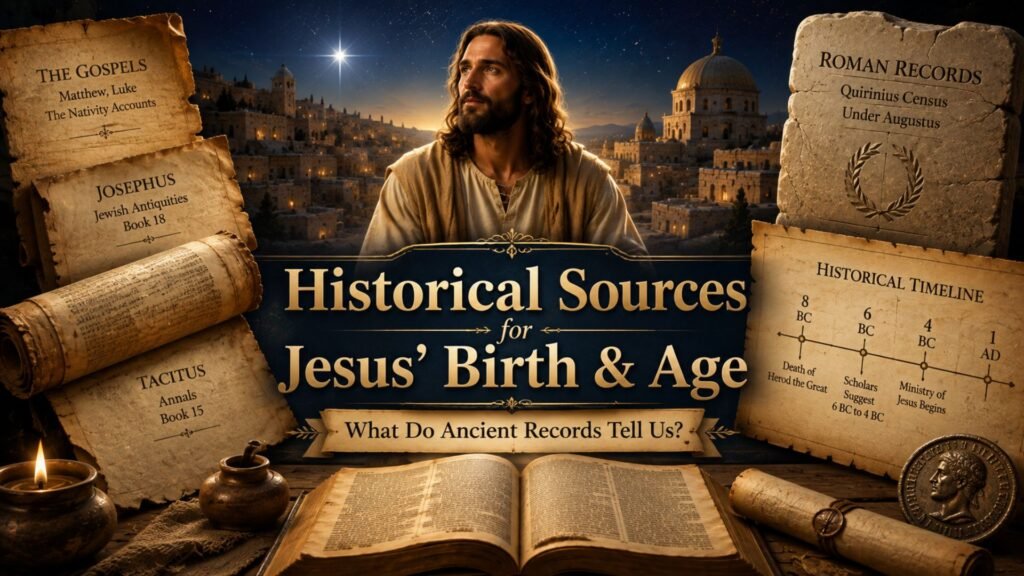
Two main types of sources shape what we know. First, there’s the biblical evidence for Jesus, found in the Gospels of Matthew and Luke. Second, there’s outside historical evidence for Jesus, mainly from Roman-era writers and records.
Josephus, a first-century Jewish historian, is especially important here. His writings confirm details about Herod’s reign, the political tension of the period, and the general timeline of events. Historians rarely rely on the Bible alone or outside sources alone. They combine both, cross-checking one against the other, to build the most accurate possible picture of biblical chronology. This blended approach is standard practice across serious biblical scholarship.
What Is the Theological Meaning of Jesus’ Age and Eternity?
Numbers only tell part of the story here. Christian theology teaches that Jesus has two natures at once. He is fully human and fully divine, which is a core belief tied to His identity as the Son of God.
In His human nature, Jesus was born, grew up, ministered, and died, just like any other person in history. That’s the part we can calculate. But in His divine nature, Christians believe He exists beyond time entirely. This is often called the eternal nature of Jesus, and it reflects a broader Christian understanding of eternity. From this historical and theological perspective, His age isn’t really the point. His enduring presence and influence are.
This distinction matters more than it might seem at first glance. If you only look at the calendar, Jesus is simply an ancient figure from a specific point in Christian history, no different from any other person born two thousand years ago. But Christian devotion treats Him very differently. Believers don’t approach Him the way historians approach Julius Caesar or Alexander the Great. They approach Him as someone whose life, death, and resurrection still speak directly into daily struggles, hopes, and decisions today. That’s the heart of Bible study for millions of people. The historical timeline gives structure to the story. The theological meaning gives it purpose.
Common Misconceptions About Jesus’ Age, Birth Year, and Year Zero
A few mix-ups come up again and again, so let’s clear them up here.
The first misconception is that Jesus was born in year zero. That year simply doesn’t exist in the calendar, so this idea is based on a misunderstanding of how BC and AD dating works. The second misconception is that Jesus was born on December 25. That date is a later Christian tradition, not something confirmed by historical records.
The third misconception is that His exact birth year is fully known. In reality, 6 BC to 4 BC remains a scholarly estimate, built from the best available evidence, not a locked-in fact. And finally, some people confuse His age at death, 33, with His age today, which are two completely different numbers answering two completely different questions.
Read More About: 20 Uplifting Short Devotions for Church Council Meetings
Frequently Asked Questions
Why is the year 2033 so important?
Some believers link 2033 to the 2,000th anniversary of Jesus’s crucifixion, since many scholars place that event around AD 33. It’s a popular date among prophecy speculation, though the Bible itself names no such date.
How old is Jesus actually?
Based on His estimated birth between 6 BC and 4 BC, Jesus would be roughly 2,029 to 2,031 years old today. It’s a range, not an exact number, since His precise birth year isn’t recorded.
What happens at 3AM in the Bible?
The Bible doesn’t assign special meaning to 3 AM specifically; that idea comes from folk tradition, not scripture. The Gospels do note Jesus died around the “ninth hour,” roughly 3 PM, which people sometimes confuse with 3 AM.
How old is Jesus supposed to be today?
Jesus would be approximately 2,029 to 2,031 years old today, based on His likely birth year of 6 BC to 4 BC. The range accounts for the missing “year zero” in the calendar.
How old is Jesus in 2026?
Jesus would be approximately 2,029 to 2,031 years old in 2026. This range comes from His estimated birth between 6 BC and 4 BC, adjusted for the missing year zero in the calendar.
Was Jesus born before AD 1?
Yes. Jesus’ birth before AD 1 is the historical consensus. Most evidence points to a birth date several years before AD 1 began, mainly because His birth had to occur before Herod the Great died in 4 BC.
How old was Jesus when he was crucified?
Jesus is traditionally believed to have been around 33 years old at His crucifixion. This comes from Gospel accounts of a public ministry lasting roughly three years, beginning around age 30.
Conclusion
So, how old would Jesus be today in 2026? Based on solid biblical chronology and historical evidence for Jesus, the answer lands somewhere between 2,029 and 2,031 years old. That range comes from His likely birth between 6 BC and 4 BC, combined with a small but important adjustment for the missing year zero in our calendar system.
But this number was never really the whole point. For millions of people around the world, Jesus’ teachings, His message of forgiveness, mercy, and hope, and the Christian belief in eternal life matter far more than any calculation ever could. His human age can be measured. His influence, according to Christian faith, cannot. And that might be the most interesting part of this whole question.






One Comment