
What Are the Challenges of Translating Christian Content Into Different Languages?

You write a heartfelt devotional. Readers in Texas love it. Then a friend in Brazil reads the Portuguese version and shrugs. The grammar is fine. The warmth is gone. This gap shows what are the challenges of translating Christian content into different languages. Words move easily between languages. Faith does not always move with them.
Christian writing carries doctrine, emotion, and history. Good Christian content translation must protect all three. This guide shows where projects fail and how to fix them. You will learn how to translate Christian books for global readers. You will also see how theological accuracy, cultural sensitivity in translation, and smart tools work together. Along the way, you will learn how Christian translation services help ministries speak to the world.
Why Accurate Translation Matters for Christian Content
Faith writing carries high stakes. A small slip in a recipe is harmless. A small slip about salvation can mislead a whole church. That is why accurate Christian translation is important. Readers trust the page to carry biblical truth and the Gospel message without change. The need is also huge. Wycliffe’s 2024 report says Bible work is underway in 3,526 languages across 173 countries. Another report adds that at least 1.3 billion people still lack the full Bible in their first language. Each number stands for real people. They deserve accurate Bible translation, careful biblical translation, and clear Gospel translation in the language of their hearts.
Accuracy also protects trust. A church that sends out a muddled book loses credibility fast. Strong Christian language translation keeps the spiritual meaning and the original intent of the author. It supports multilingual ministry and gospel outreach. It also honors translation ethics, which means telling the truth in every line. Even the experts stay humble. Wycliffe itself reminds readers that no global Bible translation statistic is ever exact. That caution should guide every team. Treat each project as ministry stewardship. Put preserving the message of Christ above speed or price.
Read More About: The Powerful Biblical Meaning of the Name Camila
Common Challenges in Translating Christian Content

Many readers ask what makes Christian translation different from general translation. The answer is depth. A business memo needs clear facts. A Christian book needs facts, doctrine, emotion, and history at once. This is why religious translation challenges feel bigger than normal language work. Every word may carry centuries of Old Testament traditions and New Testament teachings. Religious text translation and translation of sacred texts also lean on Hebrew and Greek biblical languages. One English word may cover three Greek ideas. Layout and timing add more trouble.
Skill is another problem. Why secular translators may struggle with Christian texts is simple. They may know both languages well. They may not know biblical context or church vocabulary. Plain fluency is not enough. A good faith-based translation team needs biblical literacy and linguistic proficiency. It also needs native-language fluency. The table below shows the main hurdles.
| Challenge | Example | Risk if ignored |
| Doctrinal terms | Grace, atonement, covenant | Confused beliefs |
| Bible quotes | Forty verses in one book | Wrong or mixed versions |
| Idioms | “Born again,” “carry your cross” | Odd or offensive text |
| Culture | Shepherds, yeast, vineyards | Lost meaning |
| Format | Arabic or Farsi layout | Broken pages |
| Audio | Dubbing and timing | Flat emotion |
Cultural Sensitivity in Christian Translation
Cultural sensitivity in translation shapes how readers hear your message. Jesus told stories about shepherds, yeast, and vineyards. Those images were clear in the first century. In some places today they mean nothing. This is how cultural differences affect Christian translation. A literal line may confuse readers. A short footnote or a smart cultural adaptation can fix it. Cultural consultants can review the draft and flag weak spots. Their advice builds cultural understanding and keeps the original intent. This is also how to adapt biblical references for different cultures and how to make biblical teachings culturally relevant. The result is culturally relevant Bible teaching that stays true to Scripture.
Maintaining Theological Accuracy
Theological accuracy means the translation says what the author believes. That sounds simple. It is not. Words like grace, atonement, and propitiation carry deep meaning. Many languages lack a clean match. Some borrow a term from another religion. That borrowed word may bring wrong ideas. Here is how to translate words like grace and atonement. Pick a clear term with the ministry. Record it in a theological glossary. Then use it everywhere. Doctrinal consistency matters. If justification appears three ways in one course, students may think it means three things. This shows how to maintain doctrinal accuracy in Christian literature and how to translate complex biblical terms.
Translating Bible Quotes and References
A book with forty verses holds forty small projects. Each verse needs a match in an approved text. This is how to translate Bible verses into local languages the right way. Teams use accepted Bible versions instead of inventing new wording. Here is how to choose an accepted Bible version for translation. Ask local pastors which version people trust. Check the license too. Some publishers limit how much text you may quote. Then handle Bible verse citations, footnotes, and running heads with care. Localization of Bible references may also change book names or numbering. Spanish readers often prefer the Reina-Valera text. Good Bible version selection keeps the page clear and trustworthy.
Adapting Christian Idioms and Terminology
Biblical idioms and biblical metaphors can sound strange when copied word for word. Think of being born again, carrying your cross, and washed by the blood of the Lamb. Each phrase paints a rich picture. This is how to translate Christian idioms and metaphors. First, ask what the phrase means. Next, ask how local believers express that idea. Contextual translation then finds a natural match. The Lamb of God may need a note where sheep are rare. Translation of religious metaphors also covers hymns and songs. Rhyme and rhythm matter there. Good biblical terminology feels natural and still honors biblical symbolism and spiritual nuance.
How to Overcome Christian Translation Challenges

Good news: you can fix most problems before drafting begins. Start with a clear Christian translation workflow. Build a theological glossary and a short style guide first. Add notes about your readers. Then everyone knows how to ensure consistency in biblical terminology. Translation consistency matters across books, videos, and websites. Translation memory tools also help. They store approved phrases and reuse them. This saves money and keeps wording steady. You can also ask for Christian translation consultation before work starts. One short talk can prevent months of rework.
Review is the next safety net. Native-speaking Christian translators check that the text reads well. Theological experts and biblical scholars check the doctrine. Translation proofreading and editing catches small slips. This is why proofreading matters in Christian publishing. One typo can change a verse. Christian translation quality control also adds native-speaker feedback. Here is how native speakers review Christian translations. They read aloud and flag odd phrases. Devotionals and study guides need extra care. That is how to translate Christian devotionals and study guides. Keep sentences short and the tone warm. Test discussion questions with a real group. This is also how to preserve tone and emotion in Christian writing.
| Step | Who leads | Goal |
| Glossary | Ministry and translator | Fix key terms |
| Draft | Native-speaking translator | Natural, clear text |
| Theological review | Theologian | Protect doctrine |
| Reader test | Local believers | Check clarity and tone |
| Final proof | Editor | Remove errors |
Common Mistakes to Avoid When Translating Christian Content
Many teams ask how to avoid common Christian book translation mistakes. The first mistake is picking the cheapest quote. Low price often means no doctrine review. The second is word-for-word work. It keeps the words and loses the spiritual impact. The third is mixing Bible versions in one book. Readers then see clashing styles. Another mistake is skipping a glossary. Without one, key terms drift. Teams also forget target-language readability. A text can be correct and still hard to read. Some teams even ignore source-language meaning and guess instead of asking the author.
Other mistakes hide in the details. Layout can break in right-to-left typesetting. Footnotes can vanish. Audio can run too long. A project may also change meaning by accident. Here is how to localize Christian books without changing their meaning. Change examples and settings only when needed. Never change doctrine. Protect the authorial voice too. That is how to maintain the original author’s voice. Ask the translator to match tone and rhythm. Review samples early. Teams also learn how to avoid misleading theological interpretations by asking a reviewer to check sensitive lines. The table lists common slips and quick fixes.
| Mistake | Why it hurts | Quick fix |
| Cheapest bid wins | Weak doctrine review | Hire theological experts |
| Literal translation | Stiff, unclear text | Use contextual translation |
| Mixed Bible versions | Confusing quotes | Pick one version |
| No glossary | Terms drift | Build one first |
| No reader test | Hidden errors | Gather native-speaker feedback |
The Role of Technology in Christian Content Translation
Technology now speeds up many tasks. AI-assisted translation can draft text in seconds. Wycliffe USA’s leader says software like Adapt It automates parts of the process and shortens first drafts for related languages. Translation memory tools and linguistic databases keep terms steady. These tools help Christian content localization at scale. So can AI translate Christian books accurately? Sometimes it gets the basic meaning right. Simple devotional text may need only light edits. Still, a draft is not a finished book. Quality still depends on people.
Machine translation limitations show up fast in faith content. Machines miss spiritual nuance. They may choose a wrong word for grace. They cannot weigh theological interpretation. They also cannot sense danger in restricted regions. That is why human translators are important for Christian content. Human judgment protects theological integrity. Here is how to combine AI and human translation. Let AI make a first draft. Then professional Christian translators edit it. Next, theologians review the doctrine. Finally, native readers test the result. This blend keeps costs lower and quality high.
| Tool | Best use | Limit |
| Machine translation | Quick first drafts | Misses doctrine and tone |
| Translation memory | Repeated phrases | Needs an approved glossary |
| Linguistic databases | Term checks | Needs human review |
| Human editors | Meaning and voice | Slower and costlier |
How to Choose a Christian Translation Service
Here is how to choose a professional Christian translation service. Start with proof of experience. Ask for samples in your language. Ask which Christian translation ministry or publisher they have served. Look for native-speaking Christian translators and theological experts on staff. Check the range of Bible translation services and Christian book translation services too. Many ministries also need translation of Christian books, Christian workbooks translation, and translation of devotional books. A full-service partner saves time. Ask about Christian manuscript translation, typesetting, and proofing in one place.
Confidentiality matters as well. This is how to protect confidential ministry materials. Ask for signed agreements and secure file sharing. Next, learn how to translate Christian content for restricted regions. Ask how the team handles risky phrases. Careful wording can protect readers in danger. Compare quotes with care. A fair price should include theological review. A strong partner also offers translation of theological writings and translation of ministry resources. Use the table below as a quick checklist.
| Question | What a good answer sounds like |
| Do you share our statement of faith? | Yes, and reviewers hold it too |
| How do you build a glossary? | Before drafting and shared with us |
| Who reviews doctrine? | Named theologians |
| How do you protect files? | Secure tools and signed agreements |
| Can you handle books, audio, and video? | Yes, under one team |
Why Theological Expertise Matters in Christian Translation
Fluency alone cannot guard doctrine. That is why theological knowledge matters in Bible translation. A skilled linguist may pick a lovely phrase that shifts a passage two degrees. Most readers will never notice. A biblical scholar will. How Challenges of Translating Christian Content Into Different Languages accuracy is easy to see. They check each key idea against Scripture interpretation. They compare the Hebrew and Greek with the target text. They also watch for doctrinal fidelity. This protects sacred Scripture and the Christian worldview behind it. It also guides the translation of theological writings.
Shared faith adds another layer. Believing translators understand sanctification, covenant, and agape love from the inside. They feel the weight of the work. Pastor involvement helps too. Pastors know how real people hear church words. Together, translators, scholars, and pastors show how to preserve the spiritual depth of Scripture. They also show how to protect emotional resonance. Their care shows in the final text. Readers sense it even when they cannot name it.
How Christian Translation Helps Reach a Global Audience
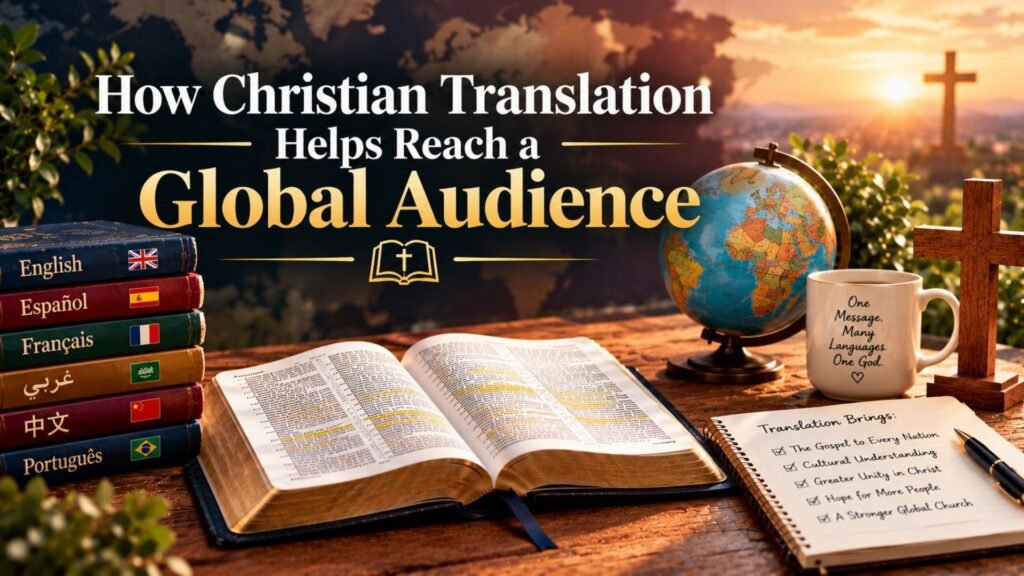
Words are only part of the story. Global Christian audiences also listen and watch. Sermon translation needs a speaker’s warmth. Here is how to translate sermons and podcasts. Keep the story flow and the pauses. Christian podcast translation needs a natural voice. Christian voice-over services and Christian video dubbing must fit the original timing. That is how Christian voice-over and dubbing work. Writers trim lines so the same weight fits fewer syllables. Audio synchronization keeps sound and picture together.
Subtitle translation helps viewers who prefer text. Teams also learn how to translate Christian videos for international audiences by testing clips with local viewers. Christian media localization and translating Christian testimonies need this same care. ASL video interpreter services add another layer. American Sign Language has its own grammar. What challenges arise when translating ASL content? The interpreter must grasp the message and sign it naturally.
Real projects show the payoff. Christian Lingua reports that its team of 1,300+ linguists and vocal talents serves over 2,000 ministries in 220 languages. In one case study, the company handled more than 30,000 minutes of video for RightNow Media in 12 languages. Its CEO said, “That’s what faithful translation looks like.” These figures come from press releases. Treat them as company-reported. Even so, they show how professional translation services help ministries reach international audiences. Good work supports international Christian publishing and Christian discipleship materials. It also shows how translation supports Christian discipleship and how to translate Christian content for global evangelism. Readers grow when they understand.
| Format | Main challenge | Best practice |
| Sermons | Spoken warmth | Translate for the ear |
| Podcasts | Natural voice | Use native voice talent |
| Dubbing | Timing | Adapt lines to fit |
| Subtitles | Space limits | Keep lines short |
| ASL | Own grammar | Use fluent interpreters |
FAQs
How do you ensure theological accuracy when translating Christian content?
Start with a theological glossary. Then add theological review, back-translation, and pastor sign-off. Biblical scholars compare key passages with the source text. Native-speaker feedback checks clarity. Together these steps protect theological accuracy, doctrinal consistency, and preserving biblical meaning.
What are the biggest challenges in translating Christian literature?
The biggest hurdles include doctrinal terms, Bible quotes, idioms, and culture. Christian literature translation also faces layout limits and tone. Teams must keep the authorial voice. They must also protect biblical truth. Strong Christian translation services handle each step.
Can Christian content be translated into regional or rare languages?
Yes. Many ministries now reach smaller language groups. Rare languages need native-speaking Christian translators and extra time. Teams may also need local cultural consultants. Plan more review and testing for these projects.
Is machine translation suitable for Christian content?
It works for rough drafts only. Machine translation limitations include weak doctrine, poor tone, and missed risk. A believing editor must review every line. This mix of AI-assisted translation and human work suits tight budgets. Never publish raw machine output.
How important is cultural adaptation in Christian translation?
It is very important. Cultural adaptation helps readers grasp parables and biblical symbolism. A literal rendering can lose the point. Light notes keep meaning clear. Never change doctrine. Cultural relevance should serve the Gospel message.
Conclusion
So, what are the challenges of translating Christian content into different languages? They include doctrine, culture, Bible quotes, idioms, timing, and risk. Each one can be solved with care. A strong theological glossary protects meaning. Native readers protect clarity. Theologians protect truth. Tools like translation memory and AI-assisted translation add speed. Human experts still make the final call. Careful Christian content translation keeps the spiritual depth and the heart of the message intact.
Now take the next step. Build your glossary early. Invite local believers into the review. Ask hard questions of any partner. A trusted team like Christian Lingua can help with books, audio, video, and more. Choose people who care about preserving the message of Christ as much as you do. Then your words will reach new readers with the same power they had at home.