
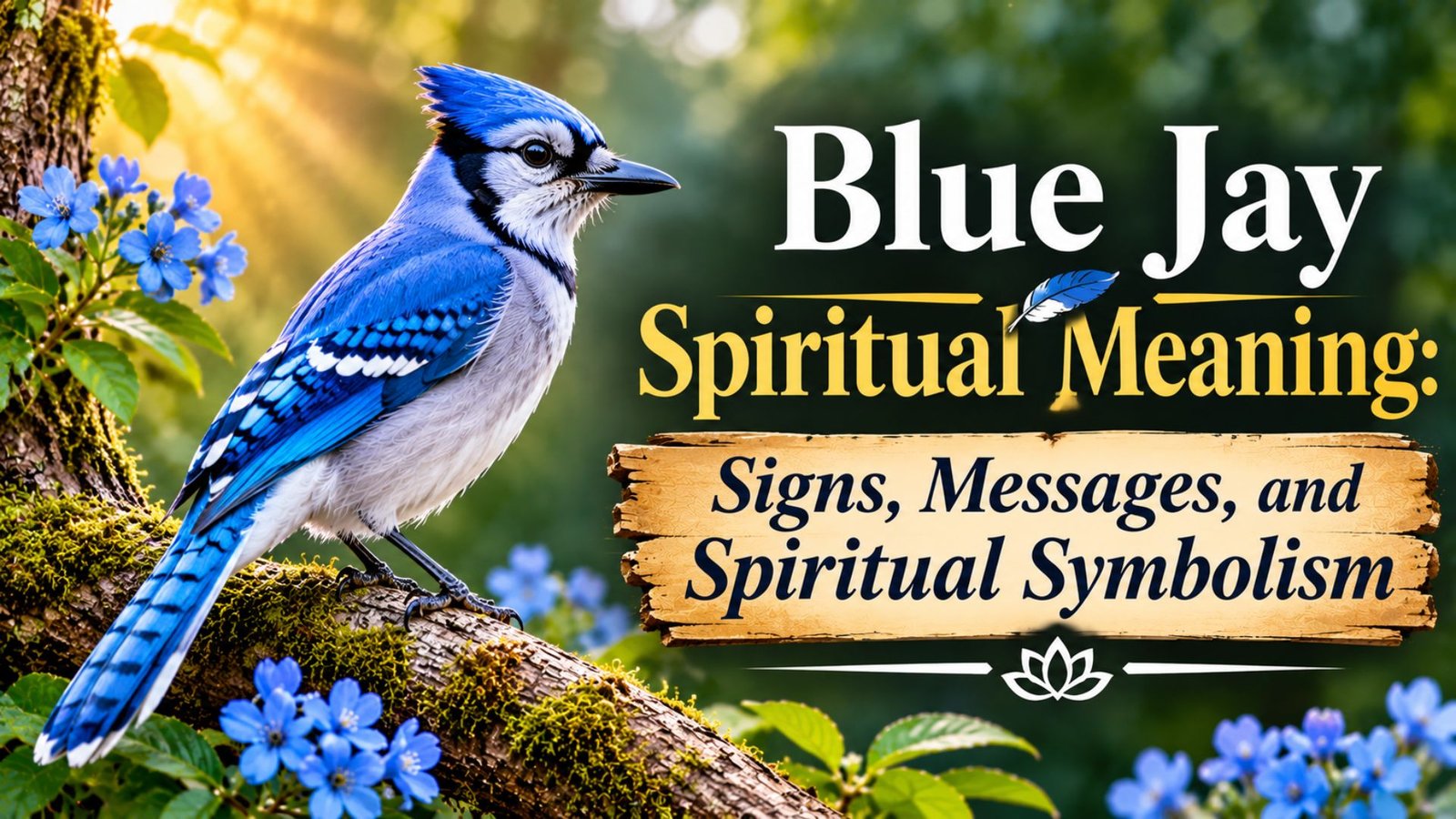
Blue Jay Spiritual Meaning: Signs, Messages, and Spiritual Symbolism

A blue jay never sneaks into a yard. It crashes the party. The loud call, the sharp crest, and the steady stare make you look up. That’s why so many Americans search for the Blue Jay spiritual meaning after a sighting. Some people read Blue Jay symbolism as a call to truth and honesty.
Others feel Blue Jay protection symbolism or a quiet hello from someone they miss. Bird sites like Birdfact and PeckPerk explore the topic too. This guide covers Blue Jay signs and messages, Blue Jay omens, feathers, dreams, folklore, and the science behind Cyanocitta cristata. Take what fits your life and leave the rest.
What Does It Mean Spiritually When You See a Blue Jay?
Seeing a blue jay often feels like a wake-up call. The Blue Jay spiritual meaning most people give centers on awareness, intuition, and self-expression. The bird doesn’t blend in. It shouts. So many readers treat Blue Jay sightings as a nudge to trust their instincts and speak plainly. Spiritual writers call this finding your voice and speaking your truth. A jay fits that theme well. It’s also a handy sign of spiritual awakening, since it asks you to notice what you’ve ignored.
Timing shapes the message. Picture a woman who spots a jay on her fence before a hard talk with her boss. She reads it as a boost of courage and confidence. Another person sees one after months of silence in a friendship. For them, it points to boundaries. The same bird can carry many meanings. That’s why Blue Jay spiritual guidance works best as a mirror. Ask yourself what you felt when the bird appeared.
What Does a Blue Jay Symbolize?
Ask “What does a Blue Jay symbolize?” and a few themes come up again and again. They include communication symbolism, personal power, inner strength, and adaptability. Each theme grows from something the bird really does. That link between behavior and Blue Jay spiritual symbolism makes the meanings feel earned. The table below shows how.
| Symbolic theme | What people read into it | Real bird behavior behind it |
| Truth and honesty | Speak plainly | Loud, varied calls |
| Courage and confidence | Stand your ground | Defends its nest boldly |
| Intelligence | Be resourceful | Member of the corvid family |
| Loyalty and commitment | Stay steady | Often mates for life |
| Protection | Guard your peace | Warns other birds of danger |
| Hidden depth | Truth sits below the surface | Blue comes from feather structure |
The corvid family link matters here. Crows, ravens, and jays share a reputation for bird intelligence. In spiritual terms, that becomes resourcefulness and quick thinking. The loyalty row comes from All About Birds, which says jays often mate for life. Together these traits explain why the bird feels like a teacher of courage, honesty, and loyalty.
Is the Blue Jay a Spirit Animal or Totem Animal?
Plenty of people claim the Blue Jay as a spirit animal. Others prefer the Blue Jay as a totem animal, meaning a lifelong guide. Books like Ted Andrews’ Animal-Speak and Steven Farmer’s Animal Spirit Guides helped popularize this way of thinking in the United States. Followers say the jay teaches clear speech and fierce loyalty to your inner circle. It also warns against noise for its own sake. These ideas are personal beliefs, not science. Use them as prompts for reflection.
Read More About: Hummingbird Spiritual Meaning: Joy, Love & Renewal Signs
Are Blue Jays Omens?
Many people treat Blue Jay omens as gentle encouragement. Imagine you’re rebuilding after a rough year. A jay lands on your porch rail. It feels like a small “keep going.” Readers often call this Blue Jay good luck, and they file it under good luck omens. Others spot synchronicity in the timing. The bird shows up as you face a life transition, and the coincidence feels meaningful.
Still, an omen is a personal reading. The same jay on an ordinary Tuesday may mean nothing at all. What matters is your mood and your question that day. Older bird superstitions also sold a darker idea of Blue Jay bad luck. You’ll see where that came from in the folklore section below. For now, remember this. The bird doesn’t predict your future. You give the moment its meaning.
What Warnings or Messages Do Blue Jays Bring?

The “warning” reading grows from real bird communication. Jays are expert mimics. In the wild they often copy Red-shouldered and Red-tailed hawks. Researchers say these hawk mimicry calls may tell other jays a hawk is near. They may also fool other species into believing danger is close (Celebrate Urban Birds). Birds at feeders sometimes scatter. The jay then eats in peace. This talent for predator warnings explains why people call the bird a watchman.
Spiritually, a Blue Jay calling loudly can feel like a spiritual warning. Take it gently. It rarely signals disaster. More often it confirms a gut feeling you’ve been pushing aside. A Blue Jay calling meaning might be: “Check that decision again.” It may also say: “You’re allowed to walk away.” Treat these spiritual messages as a pause button. They don’t replace advice from people you trust.
Is a Blue Jay a Sign From Heaven?
Grief sharpens attention. You notice small things you’d normally miss. So a jay that taps at the glass after a funeral can feel deeply personal. Many believers call the Blue Jay a messenger between worlds. They see messages from the spirit world and a connection between the physical and spiritual worlds.
People also ask, “Are Blue Jays messengers from deceased loved ones?” Many say yes. They describe a visit from the bird as comfort from loved ones in the afterlife. Some even read it as one of many divine signs.
Blue jays and cardinals often visit the same feeders. Because many people link cardinals to lost loved ones, seeing both together can feel like double reassurance. No scientific test confirms any of this. Jays are curious birds that love feeders and shiny things.
Even so, comfort has value. If a visit helps you feel close to someone, honor that feeling. If grief feels too heavy, talk to a counselor or someone you trust. Emotional healing often needs real human support too.
What Does a Blue Jay Feather Mean?
Blue Jay feathers usually center on protection, clarity, and inner strength. Finding one may feel like a pat on the back. Many see it as a prompt to say what you mean. Others see a nudge toward emotional encouragement and a stronger spiritual connection. So, “What does a Blue Jay feather symbolize?” Most answers boil down to truth with courage. As a gift from nature, the feather fits the bird’s whole story of voice and honesty.
Here’s a twist. The feather isn’t really blue. The pigment inside is melanin, which is brown. The blue comes from structural coloration, a kind of light scattering through tiny cells in the feather barbs (Celebrate Urban Birds). That is the heart of Blue Jay feathers and structural color. Crush the feather and the blue feathers fade to dull brown. It’s a lovely metaphor. Truth often lives beneath the surface.
One legal note matters too. The Migratory Bird Treaty Act protects native birds. Possessing even a single found feather is generally illegal in the U.S., and molted feathers get no exemption (Colby College). Admire it. Photograph it. Leave it where it lies.
Why Is the Blue Jay Linked to the Throat Chakra?
The Blue Jay throat chakra link starts with color. In yoga and tantric traditions, Vishuddha, the throat chakra, governs speech and honest expression. Its color is blue. The jay wears that color and also lives loudly. A balanced throat chakra lets you speak openly. A blocked one keeps you quiet to avoid conflict. Many people therefore read the jay as a cue to use their voice. Speak truthfully. Don’t speak harshly.
What Does It Mean When a Blue Jay Comes to Your Window or Home?
A window is a thin boundary between inside and outside. So the Blue Jay at the window often feels like a message knocking. Many read Blue Jay visiting your home as a sign of protection, since jays guard their nests with fierce nest protection. It can remind you to defend your peace, your family, or your time. For mourners, the visit may feel like Blue Jay and loved ones meeting for a moment. A repeated visit in the backyard may feel like emphasis.
Nature plays a part too. A jay may see its reflection and react to it. It may scan for seeds or test a new perch. Holding both views keeps you grounded. Try a simple habit. Note the time, the bird’s behavior, and your mood. Patterns show up quickly. Often the message is about what you needed to hear that day.
What Do Dreams About Blue Jays Mean?
Blue Jay dream meaning depends more on feeling than on imagery. Dream interpretation has a long history, and old dream dictionaries often tied birds to news and messages. Today, Blue Jay symbolism in dreams usually points to your inner voice. The table below sums up common scenes. Remember that no single reading fits everyone.
| Dream scene | Common reading | Question to ask yourself |
| A calling jay | Something needs saying | What am I holding back? |
| A silent or trapped jay | Suppressed emotions | What feels stuck? |
| An attacking jay | Inner conflict | Who or what am I fighting? |
| A calm jay | Growing self-trust | Where do I feel steady? |
Listening to Your Inner Voice
A jay that calls in a dream often points to inner wisdom you haven’t voiced yet. Ask what you’re not saying. Ask which feeling you keep tucked away. Then try writing the answer down. It can be more free than you expect.
Healing and Emotional Release
A silent, injured, or trapped jay often signals suppressed emotions. It doesn’t mean you’re weak. It suggests you’re carrying more than you realize. These dreams invite emotional release and gentle healing and transformation.
Confrontation and Setting Boundaries
A jay that chases or attacks echoes its territorial behavior. Ask who or what you’re quietly fighting. It could be a person or a worry. Name the inner conflict. Then speak up before resentment does the talking. This is confronting personal fears in a safe way.
Interpreting Dream Emotions
Your mood on waking matters most. Waking calm suggests peaceful bird dreams and growing trust in your voice. Waking uneasy, as after aggressive bird dreams, may point to a truth you’re not ready to face. Use the dream for self-reflection. Don’t use it as a verdict.
What Can We Learn From Blue Jay Behavior?
Blue Jay behavior teaches real lessons. Start with acorn caching. Jays carry several acorns at once. Radio-tracked birds in one study each cached 3,000 to 5,000 acorns in a single autumn (All About Birds). They forget many things. Those acorns sprout. That’s seed dispersal at work, and it fuels forest regeneration.
Jays are even credited with helping oaks spread after the last glacial period. The lesson is humbling. Small acts can grow into something lasting. The Missouri Department of Conservation adds that one jay may gather up to 4,500 acorns in fall yet remember only about a quarter (MDC).
Jays also show natural intelligence and strong social skills. Their territorial instincts make them bold defenders. They warn neighbors of danger. They adapt to suburbs and forests alike, which is a smart kind of natural adaptation.
One caution about facial recognition. Studies prove it well in crows and magpies. Evidence for blue jays is thinner. Even so, jays clearly learn who feeds them. The table below turns facts into life lessons.
| Behavior | Fact | Life lesson |
| Acorn caching | Thousands stored each fall | Plan ahead |
| Hawk mimicry | Calls may warn or bluff | Stay alert |
| Pair bonding | Often mate for life | Honor commitment |
| Alarm calls | Warn the whole yard | Speak up for others |
Blue Jays in Native American Stories and Folklore

Let’s be careful and specific. Native American folklore is not one story. In Chinookan traditions from the Pacific Northwest, Blue Jay is a trickster. Native Languages of the Americas calls him generally helpful but foolish and careless (Native Languages).
These trickster stories often feature his older sister Ioi. Ethnologist Franz Boas recorded versions in Chinook Texts (Sacred Texts). The World History Encyclopedia offers a helpful overview too. That’s a Blue Jay mythology thread rooted in real sources.
The Blue Jay symbolism in Native American culture you see online can be vague. Many pages attach meanings to Cherokee, Ojibwe, Menominee, Passamaquoddy, and Muscogee Creek peoples. Few cite tribal sources. Treat sweeping claims with care. Ethnographer James Mooney recorded Cherokee stories around 1900.
His work is a starting point. For Ojibwe traditions and other living cultural beliefs, tribal nations and cultural centers are the best guides. Good research honors who owns the story.
Southern Folklore and the Friday Devil
Southern folklore gave the jay a darker role. Tales said jays vanished on Fridays because they were carrying sticks to the devil. Others said they were carrying sand to hell. The bird became a devil’s messenger, a Friday devil of sorts. The Carolina Bird Club notes the bird was once called “Devil Bird” in the Central Carolinas (Carolina Bird Club).
Collectors traced such tales to enslaved communities of the antebellum South (UNC Libraries). These historical superstitions fed ideas of Blue Jay bad luck. Other traditional beliefs and weather folklore tied loud jays to rain prediction or storm prediction. Proof is thin. Enjoy it as a story.
Blue Jays in Literature and Art
Blue Jay literature and art show how much Americans love this bird. Mark Twain gave the jay a voice in “Jim Baker’s Blue Jay Yarn,” published in 1880 (EBSCO). Emily Dickinson wrote a poem about the jay as a neighborly warrior (Lit2Go).
Naturalists such as Henry David Thoreau and John Burroughs wrote warmly of backyard birds. Painter John James Audubon included the jay in Birds of America. These works reveal historical bird symbolism shaped by humor, grace, and respect.
Read More About: Owl Spiritual Meaning: Wisdom, Intuition, and Transformation
Is the Blue Jay in the Bible?
The blue jay isn’t named in Scripture. It’s a North American species. The Bible’s bird lists, such as those in Leviticus 11 and Deuteronomy 14, describe Near Eastern birds. Scholars also admit that identifying some Hebrew bird names is hard (Bible Hub). So Blue Jay meaning in Christianity is a matter of reflection. It isn’t doctrine. Be wary of sites that claim a “jay” appears in Leviticus.
Still, faith-minded readers find fitting parallels. Think of Jesus’ words about birds and God’s care in Matthew 6:26. Jays model watchfulness, community, and provision, since they store food for winter. That makes a gentle Christian bird symbolism lesson. Some believers also treat an unexpected visit as one of many divine signs. Hold the idea lightly. Let Scripture lead. Let the bird inspire.
Do Blue Jays Symbolize Love or Loyalty?
They do. Blue Jay loyalty and commitment come from real habits. Jays often mate for life, and the male feeds his mate while she incubates the eggs (All About Birds). That’s pair bonding in action. A common myth says both parents do everything equally. Science says only the female incubates. Even so, the partnership is strong.
So, “Do Blue Jays symbolize protection and loyalty?” Yes. Pairs defend the nest together. They share the work of raising young. In symbolism, that suggests commitment and honest talk. A jay pair can remind couples and close friends to stay loyal. Speak plainly. Show up. That’s the quiet message of Blue Jay loyalty.
Frequently Asked Questions
Are Blue Jays good luck or bad luck?
Most modern readers see Blue Jay good luck. They treat a visit as encouragement. Older Southern tales leaned toward bad luck. Neither view is proven. Your own feelings and timing decide the meaning.
What does it mean when you see a Blue Jay?
It often means “pay attention.” People link it to truth, courage, and awareness. Think about what was on your mind when the jay appeared. That context holds the real answer.
What is the Native American meaning of a Blue Jay?
It depends on the nation. In Chinookan stories, Blue Jay is a trickster. Other nations tell their own stories. Look for tribal sources before repeating claims.
What does it mean when a Blue Jay visits your window?
Many see protection or a message. Nature offers simpler reasons too, like a reflection or a nearby feeder. Both views can sit together.
Are Blue Jays rare?
Not at all. Blue jays are common across eastern and central North America (Celebrate Urban Birds). Their meaning comes from timing, not scarcity.
Do Blue Jays recognize people?
They learn who feeds them. Strong face-recognition evidence exists for crows and magpies. For blue jays, evidence is less clear.
Can I keep a Blue Jay feather?
Usually no. The Migratory Bird Treaty Act protects native birds, and possession of their feathers is generally illegal. Enjoy the feather and leave it in place.
Why are Blue Jays tied to truth and communication?
They’re loud, varied, and expert mimics. Their blue color also matches the throat chakra. Together these traits make the bird a symbol of honest speech.
Conclusion
A blue jay often arrives at a turning point. Some people feel protection or a hello from someone they miss. Others hear a call to speak up and stand tall. The Blue Jay spiritual meaning blends truth, courage, loyalty, and awareness. Folklore and science add depth. The bird hides acorns, warns its neighbors, and wears a color made of light.
So next time one lands nearby, pause for a moment. Watch. Listen. Notice how you feel. Like a buried acorn, a small act of honesty can grow into something strong. That’s the quiet gift of the blue jay.