
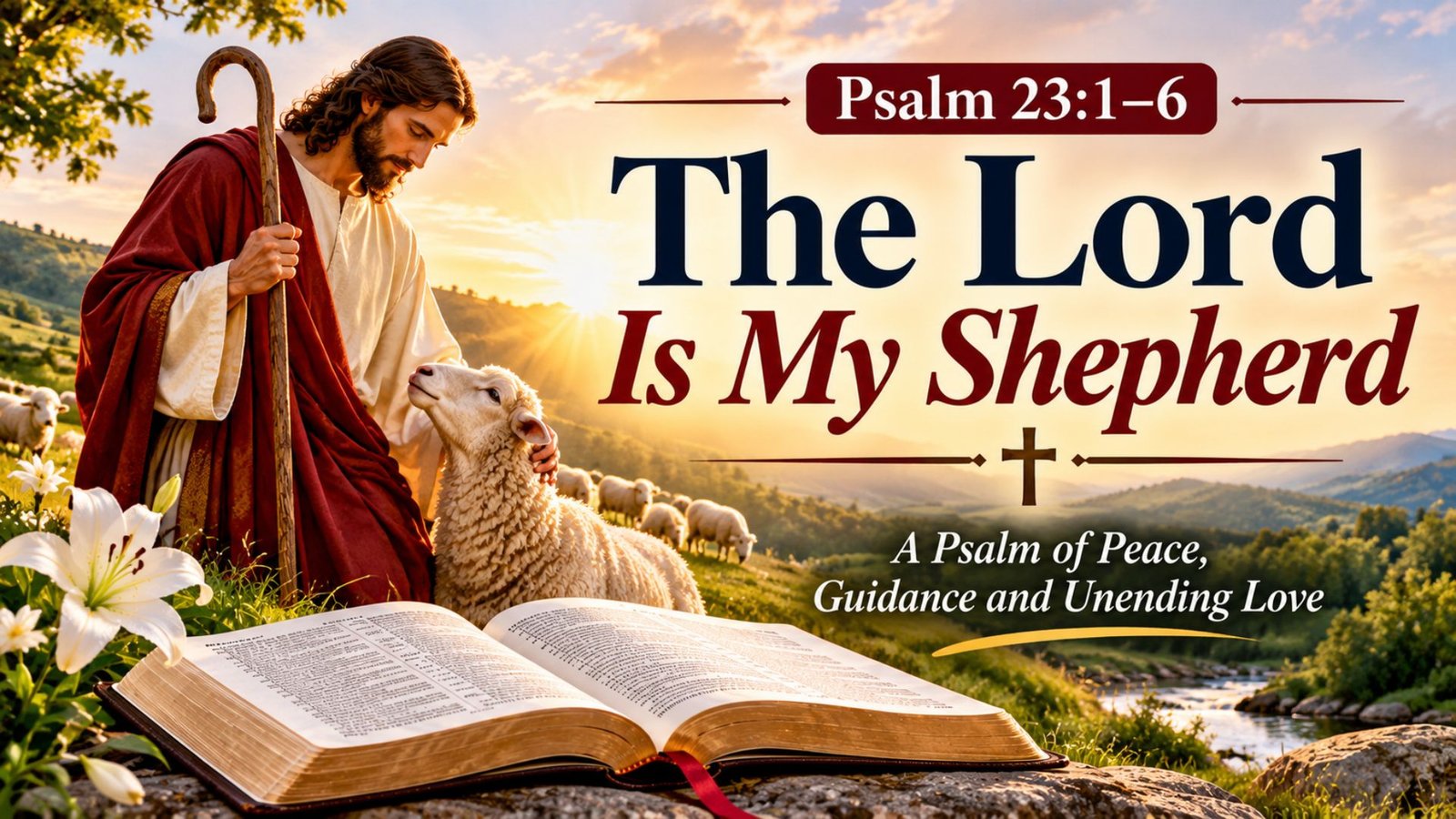
Psalm 23:1–6 – The Lord Is My Shepherd

Picture a quiet hospital room. A family gathers around a bed. Someone whispers, “The Lord is my shepherd.” The room softens. That is the power of Psalm 23 Bible verses. In this guide to Psalm 23:1–6 explained, you’ll see what each line means.
You’ll also learn how to use it today. Along the way, we’ll look at King David’s Psalm, the biblical shepherd imagery behind it, and the Lord who stands at its center. You can read the full text at Bible Gateway first if you like.
What Does Psalm 23:1–6 Mean?
Psalm 23 meaning starts with a simple picture. A shepherd cares for his sheep. A flock has no power alone. It needs food, water, rest, and protection. David uses this scene to show how God treats you. The psalm moves in a clear path. It begins in green pastures. It passes through a dark valley. It ends at a feast and a lasting home. What does Psalm 23 teach us about God? It teaches that he is near, strong, and kind.
The psalm also has two scenes. In verses 1 to 4, God is the shepherd. In verses 5 and 6, God is the generous host. Shepherds in the Bible were not soft figures. They fought wolves and lions. Rulers and gods were often called shepherds too. So God as King and Shepherd is a bold claim. The table below gives a quick view.
| Verse | Main Image | Core Meaning |
| 1 | Shepherd and sheep | God’s divine provision and trust |
| 2–3 | Pastures, waters, paths | Rest, restoration of the soul, guidance |
| 4 | Dark valley, rod, staff | God’s presence in difficult times |
| 5 | Table, oil, cup | Honor and God’s abundant blessings |
| 6 | Following goodness, a house | Eternal life with God |
The Lord Is My Shepherd
The Lord is my shepherd and is the heart of the psalm. What does the Lord is my shepherd mean? It means you belong to him. He leads you. He feeds you. He guards you. Notice the word “my.” David does not say “a” shepherd. He says “my” shepherd. That makes it personal. It is a statement of Christian faith and confidence.
Some scholars, including John Goldingay, note that it can also answer a question. Who is your shepherd? David answers that the Lord is. He does not trust other gods, kings, or money.
Why David described God as his shepherd is easy to see. David grew up caring for sheep. God later called him from the flock to lead Israel (see 1 Chronicles 17:7). So David knew the work well. He knew how helpless sheep can be.
He also knew what a good shepherd does. Later, Jesus Christ the Good Shepherd used this same picture. He said he lays down his life for his sheep (John 10:11). That is the biblical meaning of the Good Shepherd. It points to God as our shepherd in love and sacrifice.
Read More About: What Is the Bible? Understanding Its Meaning and Purpose
God Provides for All Our Needs

“I shall not want” is a bold line. It does not mean you get every wish. It means you lack nothing you truly need. This is God’s divine provision. How God provides for His children often looks quiet. It comes as daily bread, steady work, or a friend at the right time. Think of a family with a tight budget. They pray. They plan. Then a small gift arrives in the mail. Nothing flashy happens. Yet the need gets met. That is God’s providence at work. It is God’s loving care in plain clothes.
This idea shows up all through Scripture. Paul writes that God will supply every need (Philippians 4:19). Israel also learned this lesson. In the desert, God sent manna each morning. That was God’s provision in the wilderness. The people had to trust him one day at a time. You can do the same. How to depend on God instead of worldly strength begins here. Count past gifts. Thank him for them. Then ask for today’s bread. Over time, your worry shrinks and your trust grows.
God Leads Us on the Right Path
Verses 2 and 3 show two kinds of care. First, the shepherd supplies green pastures and still waters. Second, he leads you on paths of righteousness. Understanding the meaning of green pastures and still waters is simple. Sheep fear fast rivers. They will not drink there. So the shepherd finds calm water. In the same way, God gives spiritual nourishment and calm. He meets your soul where it is. He does not rush you. That is divine guidance and direction with a gentle hand.
Now consider the path. God’s guidance through paths of righteousness matters when you face big choices. You may be choosing a job, a move, or a marriage. The psalm says he guides “for his name’s sake.” That means his own good name is at stake. He will not lead you carelessly. For more on this, read Proverbs 3:5–6. It tells you to trust him and not lean on your own insight. Walking in righteousness is not about being perfect. It is about following the one who knows the road.
Finding Peace in God’s Presence
Sheep only lie down when they feel safe. That is a key detail. They must be free from fear, hunger, and pests. So when David says God “makes me lie down,” he shows trust. This is finding peace in God’s presence. It is also peaceful amid life’s storms. The outside world may be loud. Yet your soul can rest. God’s quiet waters are not a place to escape life. They are a place to gain strength for it. This is spiritual restoration in everyday form.
How to experience peace during difficult times takes practice. Our phones buzz all day. Our minds race at night. Try a small habit. Spend five quiet minutes each morning with this psalm. Read it slowly. Breathe. Then offer a short Psalm 23 prayer: “Lord, you are my shepherd. Help me rest in you today.” Over a few weeks, you may feel calmer. How God restores your soul and strength often happens in small steps. It is like a slow sunrise. You may not see it move. Still, the light grows.
God Is With Us in the Valley of the Shadow of Death
Verse 4 is the turning point. The tone shifts from “he” to “you.” David now speaks straight to God. Why? Because trouble brings God close. The valley of the shadow of death is a place of darkness and danger. What does the valley of the shadow of death mean? It means any deep trial. It can be sickness, grief, loss, or fear. Many modern Bibles read “the darkest valley.” Either way, the point is the same. You can fear no evil because God’s presence in the darkest valley is real.
Look closely at one word. David says “through.” He does not say he stays in the valley. He walks through it. That is a hopeful detail. How to overcome fear through God’s presence starts with that truth. The valley has an end. Also, you are not alone inside it. God’s presence during suffering and uncertainty is steady. You may still feel afraid. That is normal. Yet fear and faith can walk together. How to remain faithful during life’s darkest seasons is to keep walking. Take one step. Then another. Pray as you go.
God’s Protection and Comfort
Next comes the shepherd’s rod and staff. The rod was a short club. The shepherd used it to fight off wolves and thieves. The staff was a long crook. He used it to guide sheep and pull them from danger. So how God’s rod and staff provide comfort is clear. One protects. One guides. Together they show God’s protection and guidance. This is divine protection during adversity. It is not a vague feeling. It is active care. The shepherd acts for his sheep. That brings God’s comfort and strength to a weary heart.
Here are three ways this protection shows up. God defends you from harm. God steers you away from wrong turns. God lifts you when you fall. Each one is a form of God’s loving care. For more Bible verses about comfort and protection, see Isaiah 41:10. It says, “Fear not; for I am with thee.” Finding comfort in God’s promises is a daily choice. Read them. Repeat them. Let them settle in. Over time, you will lean on them as a shepherd leans on his staff.
God Prepares a Table Before Us

Verse 5 changes the scene. Now God is a host. He sets a table “in the presence of my enemies.” This is God’s provision even when surrounded by enemies. Your foes do not vanish. Yet you still feast. That is protection from enemies in a surprising form. It means peace can exist inside conflict. Think of a worker who faces harsh criticism. She keeps her calm. She does her best. In time, she finds quiet respect. Her trouble did not end first. Her peace came first. That is God’s faithfulness at the table.
The verse also speaks of oil and a cup. The biblical meaning of anointing the head with oil is honor. A host anointed guests he valued. Kings were anointed too. So the oil marks you as treasured. What does it mean to have an overflowing cup? It means God’s abundant blessings beyond your need. The cup is not just full. It spills. This is God’s unconditional love shown through generosity. You do not earn it. You receive it. As a result, you can share it with others around you.
Goodness and Mercy Will Follow Us
Verse 6 begins with “surely.” David is certain. God’s goodness and mercy will follow him all his days. The Hebrew word for “follow” can also mean “pursue.” So these two gifts chase you. They do not wait for you to catch up. The word for mercy points to steadfast, loyal love. It is God’s unfailing love that does not quit. The meaning of God’s goodness and mercy is that his kindness is not rare. It comes behind you each day. How God’s goodness and mercy follow believers throughout life is a strong source of hope.
The psalm ends with a home. David longs for dwelling in the house of the Lord. What does dwelling in the house of the Lord mean? It means close fellowship with God. It starts now and lasts forever. This points to eternal life with God. Christians also see a link to the New Heaven and New Earth. Here, keeping your eyes fixed on eternity brings courage. Problems feel smaller when home is certain. Picture a friend who always shows up. That friend never leaves. God is that friend and more. His God’s faithfulness through every season of life never runs dry.
What Psalm 23 Teaches Us About Trusting God
The psalm gives clear lessons on trusting God through difficult times. It shows that God leads, feeds, guards, and welcomes you. It also shows that leaders need him. Alastair Roberts, in his article The King’s Shepherd—Psalm 23:1–6, makes a sharp point. He notes that David was a king. Yet David called himself a sheep. Even rulers are weak without God. This is the relationship between shepherding and biblical leadership. A good leader follows a greater shepherd first.
That idea matters today. Understanding God’s sovereignty over rulers and nations gives balance. Kings rise and fall. God’s authority over nations does not change. God’s sovereign rule stands above every office. So why earthly leaders need God’s guidance is plain. Their power is borrowed. When you pray for leaders, pray for their wisdom and humility too. The table below sums up the main lessons.
| Lesson | Verse | Takeaway |
| Dependence | 1 | You need a shepherd |
| Guidance | 2–3 | He knows the way |
| Courage | 4 | Fear no evil with him near |
| Honor | 5 | He lifts you up in conflict |
| Hope | 6 | Eternal life with God awaits |
How to Apply Psalm 23 to Daily Life
Knowing the psalm is good. Living it is better. How to trust God as your shepherd starts with small acts. Memorize one verse each week. Pray the psalm out loud. Write down where you need guidance. Then share it with a hurting friend. You can also build a habit of daily devotion. A short prayer for peace and strength each morning sets the tone. How to live with confidence in God’s protection grows from such habits. Trust is a muscle. It gets stronger with use.
Many readers like a plan. Here is a simple seven-day path. It moves through the psalm one step at a time.
| Day | Focus | Short Action |
| 1 | Verse 1 | Name your needs and thank God |
| 2 | Verse 2 | Rest in quiet for ten minutes |
| 3 | Verse 3 | Ask for guidance on one choice |
| 4 | Verse 4 | Pray through one fear |
| 5 | Verse 5 | Forgive or bless one rival |
| 6 | Verse 6 | Note three gifts from this week |
| 7 | Whole psalm | Read it aloud and give thanks |
Which verse speaks to you most? Share it with a friend today. It may be the very word they need.
Read More About: What Is My Spiritual Gift? 15 Spiritual Gifts and How to Identify Yours
FAQs
What is the full verse of Psalm 23?
Psalm 23 has six verses in all. They begin with “The LORD is my shepherd; I shall not want” and end with dwelling in the house of the Lord forever. You can read the full text in the KJV at Bible Gateway.
Why is Psalm 23 so powerful?
It speaks to God’s presence in difficult times in simple, vivid pictures. Its message of God’s comfort and strength reaches people in grief, fear, and joy alike.
Can you read Psalms 23 please?
Yes. You can read all six verses in the KJV or NIV at Bible Gateway. I can’t paste the NIV text here because of copyright, but I can walk you through each verse or write a short Psalm 23 prayer with you.
Is Psalm 23 a prayer?
Yes. It is a song-prayer of trust, and David speaks to God and about him. Many believers pray it aloud as a prayer for peace and strength.
When to pray Psalm 23?
Pray it any time you need to find peace in God’s presence. It fits mornings, bedtime, hospital visits, funerals, and hard days when fear feels loud.
Which religion recites Psalm 23?
Christians and Jews both recite it. It sits in the Hebrew Bible, where Jews call the book Tehillim, and in the Christian Old Testament, where believers also link it to Jesus Christ the Good Shepherd.
What is the main message of Psalm 23?
The main message is that God cares for his people at every stage of life. He provides for you. He guides you. He protects you in danger. He stays with you in dark times. He welcomes you into his home forever. In short, what Psalm 23 teaches us about God is that he is a faithful shepherd and a kind host. You can trust him both today and eternity.
What does “The Lord is my shepherd” mean?
It is a personal statement of trust. It says God leads, feeds, and defends you the way a shepherd cares for his flock. It also shows his authority. In ancient times, shepherd was a title for kings. So the phrase blends tenderness with power. For Christians, it also points to Jesus Christ the Good Shepherd, who gave his life for his sheep and leads his people today.
What does Psalm 23 say about God’s protection?
Psalm 23 says God protects you in several ways. His rod and staff guard and guide you. His presence calms your fear in the valley. He even sets a table for you while enemies watch. This shows God’s protection in the presence of enemies. It also shows that everlasting protection is part of his promise. You may face trouble. Yet you will not face it alone.
What does the valley of the shadow of death mean?
It describes any dark and frightening stretch of life. It can mean literal death. It can also mean grief, illness, or deep fear. The key point is that you walk through it. You do not stay there. God walks with you every step. His divine companionship turns a lonely road into a shared journey. That is why David says he will fear no evil.
Conclusion
Psalm 23:1–6 – The Lord Is My Shepherd takes you on a full journey. You start in green pastures. You walk through a dark valley. You sit at a rich table. You end in a lasting home. Each step shows the spiritual meaning of God’s shepherding care. It also shows how to find lasting peace and security in God. The Holy Spirit and the gospel bring these words to life for believers today. Through Christ, God’s unconditional love is open to you.
So take a few minutes today. Read the psalm out loud. Pray it slowly. Let each line sink in. Then pass it on to someone who needs hope. A shepherd who never fails is leading you. God’s faithfulness through every season of life will carry you home. If this guide helped you, share it or subscribe for more Bible studies.

One Comment