
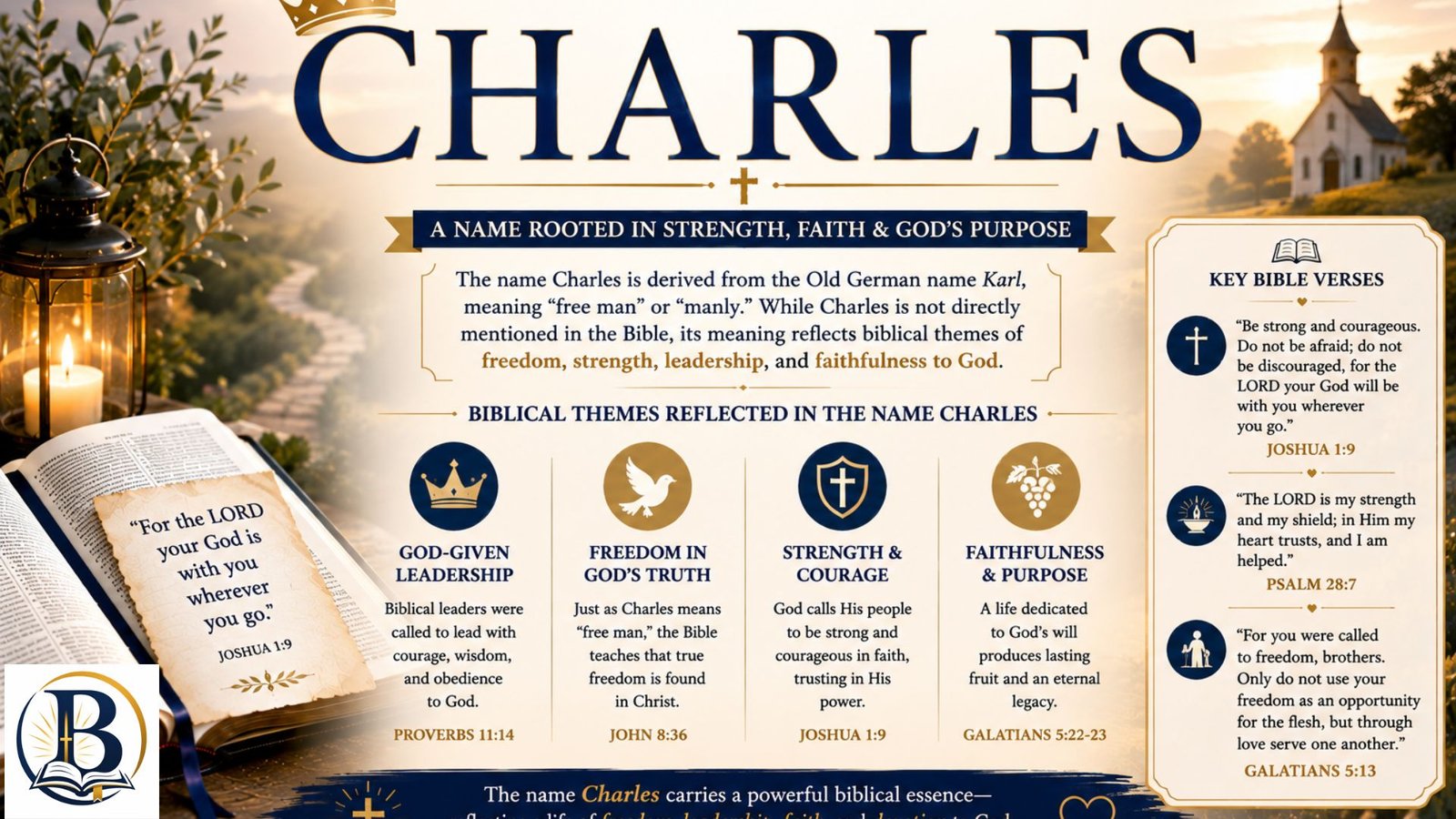
The Powerful Biblical Meaning of the Name Charles Explained

Names carry weight. They shape how people see themselves. They can even point toward a deeper calling. The Biblical Meaning of the Name Charles is one of those names people search for again and again. Parents want to know if it holds any spiritual weight. Believers want to know if it lines up with Christian values. This article walks through the full picture. It covers the Germanic origin of Charles, its ties to biblical themes, and what it means to carry this name with biblical purpose today.
Charles is a name with deep roots and a strong sound. It feels solid. It feels dependable. And as you will see, its meaning fits neatly into biblical principles about freedom, strength, and godly leadership.
What Does the Name Charles Mean in the Bible?
Charles does not appear anywhere in Scripture. There is no verse that names Charles. But the Charles name meaning in the Bible conversation is not really about a direct mention. It is about meaning. Charles comes from the old Germanic word Karl, and it means free man or strong man. That single meaning connects to some of the biggest ideas in the Bible: freedom, strength, and identity in Christ.
So here is the direct answer. The biblical meaning of Charles is tied to the idea of a free man set apart by spiritual courage and inner strength. It is not a name from Hebrew Scripture. It is a name whose meaning echoes what Scripture teaches about freedom through Christ and biblical strength. That is the heart of the spiritual meaning of Charles.
The Origin and Meaning of the Name Charles
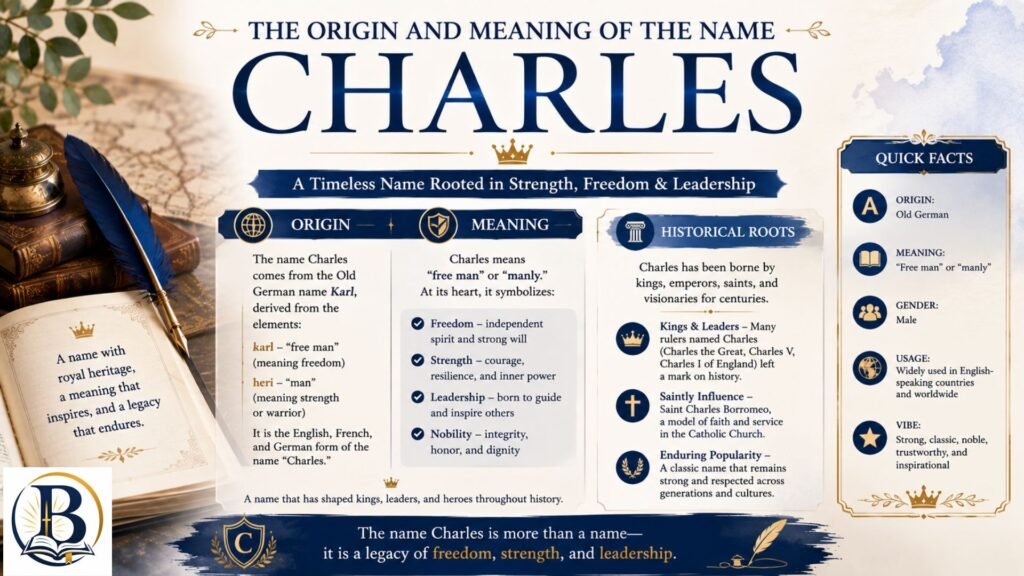
Charles has a long history. It did not start as a Christian name. It started as a term for a certain kind of man in early European society. Over centuries, it grew into one of the most common names in the Western world. Understanding where it came from helps explain why its meaning still resonates today.
The name traveled through many cultures before it became “Charles” in English. Each version kept the same core meaning. That consistency is rare for a name this old, and it is part of why the Charles meaning still feels so strong and unified today.
Germanic Origin
The Germanic origin of Charles traces back to the Old High German word Karl. This word was used to describe a free member of a household or tribe, someone who was not a servant or a slave. He held a certain status. He had rights. He had a voice.
Karl’s meaning eventually spread across Europe through trade, war, and royal bloodlines. The French turned it into “Charles.” The Spanish turned it into “Carlos.” The Italians turned it into “Carlo.” Each version kept the same root idea. A man who is free. A man with standing. This is where the Germanic name Charles gets its backbone.
Meaning of “Free Man”
The free man meaning behind Charles is not just about legal status. In ancient society, a free man could own land. He could make his own choices. He answered to no master but himself and his ruler. That is a powerful picture, and it is easy to see why this meaning has lasted so long.
Now bring that into a Christian lens. The Bible teaches a different, deeper kind of freedom. Freedom in Christ is not about land or legal rights. It is about being set free from sin. Galatians 5:1 says, “It is for freedom that Christ has set us free.” That verse gives the strong man meaning behind Charles a spiritual upgrade. A man who is free is also a man who can stand firm, and standing firm takes real strength.
Does Charles Have Hebrew Roots?
Many people assume that names with biblical significance must come from Hebrew. That is a fair guess, but it is not true here. Charles has no Hebrew roots at all. It comes entirely from Germanic language and culture.
Still, people keep asking this question, and there is a good reason why. Names like Charles carry meanings that feel biblical even without a Hebrew origin. The idea of a free man and a strong man shows up again and again in Scripture, even if the actual word “Charles” never does. So while the name is not Hebrew, its Christian meaning still holds up.
Read More About: The Awesome Biblical Meaning of the Name Nora Hidden Spiritual Truths
Is Charles Mentioned in the Bible?
This is one of the most searched questions tied to this name. The short answer is no. Charles never appears in any book of the Bible, Old Testament or New Testament. There is no King Charles in Scripture. There is no prophet, apostle, or minor character named Charles.
But that does not mean the name lacks biblical symbolism. Plenty of names carry weight without appearing on the page. What matters more is whether the meaning behind the name reflects biblical truth. And Charles does that well.
Is Charles a Biblical Name?
Technically, no. A “biblical name” usually means a name that shows up somewhere in Scripture, like David, Peter, or Sarah. Charles does not fit that strict definition.
However, many people use “biblical name” more loosely. They mean a name whose meaning lines up with biblical character traits. Under that wider definition, Charles fits well. Its meaning of free man and strong man connects directly to themes the Bible teaches over and over: strength through faith, freedom through obedience, and courage under pressure.
Why Charles Is Connected to Biblical Values
The Biblical Meaning of the Name Charles is rooted in its spiritual symbolism rather than a direct mention in Scripture. Although Charles does not appear as a biblical name, the Biblical Meaning of the Name Charles reflects powerful biblical themes of freedom, strength, courage, and faithful leadership. The Bible teaches that true freedom is found in Christ, making the Biblical Meaning of the Name Charles especially meaningful for Christians who value a life of faith, purpose, and spiritual liberty.
The Biblical Meaning of the Name Charles also aligns beautifully with God’s repeated call for His people to live with courage and unwavering trust. In Joshua 1:9, God declares, “Be strong and courageous… for the Lord your God will be with you wherever you go.” This verse perfectly reflects the Biblical Meaning of the Name Charles, emphasizing the qualities of bold leadership, steadfast faith, and confidence in God’s presence.
A faithful leader is called to walk in strength rather than fear, to serve with humility, and to trust God’s guidance in every circumstance. These enduring biblical principles give the Biblical Meaning of the Name Charles a rich spiritual significance, making it a meaningful choice for Christian families seeking a name that symbolizes courage, freedom in Christ, and godly leadership.
The Spiritual Meaning of the Name Charles
The Biblical Meaning of the Name Charles extends far beyond its historical origin and linguistic roots. Many parents exploring the Biblical Meaning of the Name Charles are not only interested in where the name comes from but also in what it represents on a spiritual level. They want a name that reflects biblical values and inspires a life of faith. The Biblical Meaning of the Name Charles is often associated with strength, freedom, humility, wisdom, and servant leadership, qualities that are deeply woven throughout Scripture.
The five spiritual themes explored below each reflect an important biblical principle that enriches the Biblical Meaning of the Name Charles. Together, they portray a person who is grounded in God’s truth, humble in heart, and committed to leading with integrity rather than pride. The Biblical Meaning of the Name Charles reminds believers that true leadership is marked by faithfulness, compassion, courage, and dependence on God rather than personal ambition. These timeless qualities make the Biblical Meaning of the Name Charles a meaningful choice for Christian families seeking a name that reflects godly character and enduring biblical values.
| Spiritual Theme | Biblical Connection |
| Freedom in Christ | Galatians 5:1 — freedom found through salvation |
| Strength through Faith | Joshua 1:9 — courage rooted in God’s presence |
| Humility | Matthew 20:26 — greatness through serving others |
| Leadership | Ephesians 5:8 — walking as children of light |
| Integrity | Proverbs 20:7 — the righteous man walks blamelessly |
Freedom in Christ stands at the center of this name’s meaning. A free man, in the biblical sense, is not someone who does whatever he wants. He is someone released from sin’s grip, walking instead in grace. Strength through Faith builds on that freedom. It is not physical muscle. It is the quiet, steady kind of strength that comes from trusting God even in hard seasons. Humility keeps that strength in check, since real strength without humility can easily turn into pride. Leadership flows naturally once freedom, strength, and humility are in place, because people trust a leader who does not need to prove himself. And integrity ties it all together, because a name means little if the character behind it does not match.
Biblical Themes Associated with the Name Charles
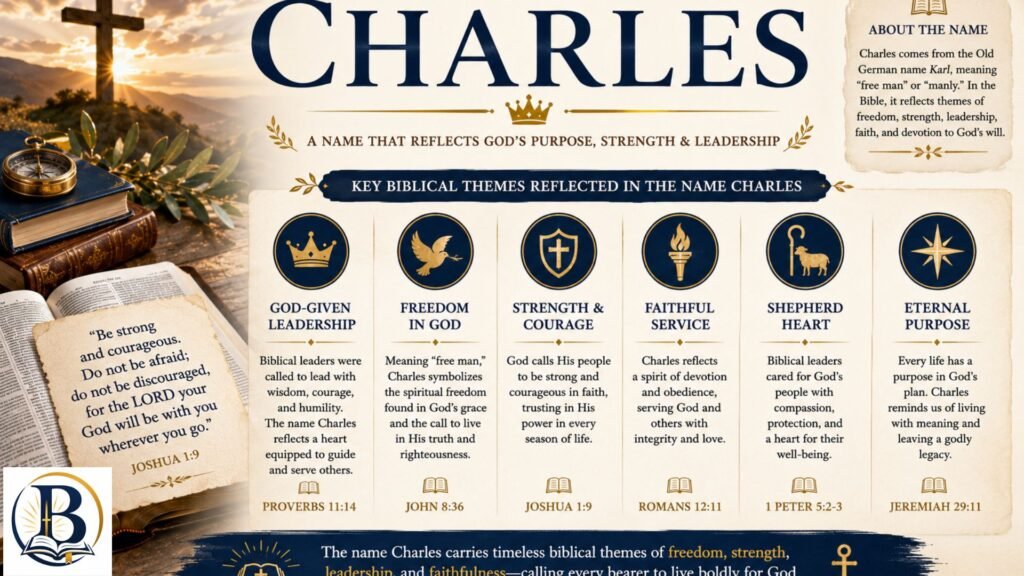
To fully understand the Biblical Meaning of the Name Charles, it is helpful to explore four key spiritual themes that are consistently associated with this name. These are not merely symbolic ideas—they reflect enduring biblical truths found throughout both the Old Testament and the New Testament. The Biblical Meaning of the Name Charles is enriched by these scriptural principles, revealing a life characterized by faith, courage, humility, and godly leadership.
Each of the themes below highlights a unique aspect of the Biblical Meaning of the Name Charles, yet together they form a complete picture of Christian character. A person who experiences freedom in Christ naturally grows in strength and courage, while someone who embraces servant leadership develops integrity, humility, and noble character.
This connection beautifully illustrates the Biblical Meaning of the Name Charles, a name that symbolizes spiritual maturity, faithful leadership, and a heart devoted to God’s purpose. These timeless biblical qualities continue to make the Biblical Meaning of the Name Charles a meaningful and inspiring choice for Christian families.
Freedom in Christ
The apostle Paul wrote extensively about freedom. In Galatians 5:1, he urges believers to stand firm and not fall back into slavery, meaning slavery to sin and old patterns of living. This is the clearest biblical picture of what freedom through Christ really means.
For someone named Charles, this theme offers a daily reminder. True freedom is not about doing whatever feels good. It is about being released from guilt, shame, and fear, and walking instead in grace. John 8:32 backs this up too: “You will know the truth, and the truth will set you free.” That verse gives the name Charles a rich, ongoing spiritual invitation.
Strength and Courage
The Biblical Meaning of the Name Charles is closely connected to the biblical call for strength and courage. One of the clearest examples is Joshua 1:9, where God commands Joshua to “be strong and courageous,” not because of his own abilities, but because of God’s constant presence and faithfulness. This powerful promise beautifully reflects the Biblical Meaning of the Name Charles, reminding believers that true strength comes from trusting God rather than relying on human power. For those who value the Biblical Meaning of the Name Charles, this verse highlights a life marked by confidence, perseverance, and unwavering faith.
The Biblical Meaning of the Name Charles also teaches that biblical strength goes far beyond physical ability. Throughout Scripture, strength is primarily understood as spiritual courage, especially during seasons of difficulty and uncertainty. In 1 Corinthians 16:13, believers are encouraged to “Be on your guard; stand firm in the faith; be courageous; be strong.”
This verse captures the heart of the Biblical Meaning of the Name Charles, emphasizing steadfast faith, resilience, and courageous leadership. Together, these biblical teachings reveal the Biblical Meaning of the Name Charles as a symbol of spiritual strength, faithful endurance, and a life that confidently follows God’s calling.
Servant Leadership
Leadership in the Bible does not look like leadership in the world. Matthew 20:26 flips the usual idea of power on its head: “Whoever wants to become great among you must be your servant.” That is the model of servant leadership, and it stands in direct contrast to leadership built on ego or control.
Anyone named Charles who wants to walk in godly leadership can look to this verse as a compass. Leading well does not mean demanding respect. It means earning trust through service, patience, and consistency. That is a harder path, but it is the one Scripture points toward again and again.
Noble Character
Proverbs 20:7 offers a beautiful picture of legacy: “The righteous man walks in his integrity; his children are blessed after him.” This verse ties biblical integrity to something bigger than the individual. It affects the next generation too.
Noble character is not built overnight. It is built through small, consistent choices, choosing honesty when lying would be easier, choosing patience when anger feels justified. This is the kind of moral excellence the name Charles has come to represent through centuries of use by men who tried to live this way.
Christian History and the Name Charles
Names often gain extra meaning through the people who carried them. Charles has been used by kings, reformers, preachers, and saints throughout Christian history. That history adds another layer to the name’s spiritual weight.
Looking at real historical figures named Charles helps ground the spiritual themes discussed earlier. These were not abstract ideas to them. They lived out freedom, strength, and leadership in very real, very public ways.
Saints Named Charles
The Catholic Church recognizes several saints who carried this name. Saint Charles Borromeo lived in the 1500s and became known for his reform work within the Church. He cared deeply for the poor and worked hard to improve education for priests. His life reflected biblical righteousness in action, not just in words.
Saint Charles Lwanga was a young martyr in Uganda during the 1880s. He died for refusing to give up his Christian faith, showing extraordinary spiritual courage under threat of death. Saint Charles of Sezze was an Italian friar known for his humility and devotion to prayer. Together, these three men show how differently the name Charles has been lived out across cultures and centuries, yet all point back to the same core values of faith, sacrifice, and service.
Charles in Christian Tradition
Beyond canonized saints, other men named Charles left a mark on Christian history. Charlemagne, crowned emperor in the year 800, helped spread Christianity across much of Western Europe. His reign blended political power with religious mission, for better or worse, and his name became forever tied to Christian leadership in medieval Europe.
Charles Wesley co-founded the Methodist movement alongside his brother John. He wrote thousands of hymns, many of which churches still sing today, like “Hark! The Herald Angels Sing.” Charles Spurgeon, often called the “Prince of Preachers,” delivered powerful sermons in London during the 1800s that still get read and studied by pastors today. These men show how the name Charles has walked hand in hand with Christian discipleship and ministry for centuries.
Personality Traits Commonly Associated with Charles
People named Charles often display a recognizable set of traits. These are not guarantees, of course, but patterns that show up often enough to be worth naming. Below is a table summarizing five common traits linked to this name.
| Trait | How It Shows Up |
| Leadership | Naturally steps up in group settings |
| Wisdom | Thinks before reacting, values good counsel |
| Responsibility | Follows through on commitments |
| Compassion | Shows care for others, especially the struggling |
| Faithfulness | Stays loyal to people and to God over time |
Leadership tends to be the trait people notice first. Someone named Charles often finds himself in charge of a project or a team, sometimes without even trying. Wisdom usually follows close behind, since good leaders learn to pause and think rather than react. Responsibility shows up in the small things, showing up on time, keeping promises, following through. Compassion softens all of this, since strength without compassion becomes harsh. And faithfulness ties it all together, whether that means loyalty to a spouse, a friend, or God himself.
Biblical Lessons and Life Applications for Someone Named Charles

Knowing the meaning of a name is one thing. Living it out is another. This section offers practical, everyday ways someone named Charles, or anyone drawn to this name’s meaning, can apply these biblical lessons in real life.
Living with humility means putting others first, even when it costs something. It means admitting mistakes quickly instead of defending pride. Leading with integrity means doing the right thing even when no one is watching, staying honest in small conversations as well as big decisions. Trusting God’s guidance means slowing down before big choices and asking for wisdom instead of rushing ahead alone. Serving others faithfully means looking for small ways to help daily, not just in dramatic moments but in ordinary ones too, like listening well or showing up consistently for people who need support.
These four lessons work together. Hebrews 12:1 offers a fitting picture here: believers are called to run their race “with perseverance.” That is exactly what living out the Biblical Meaning of the Name Charles looks like in daily life. It is not a one-time decision. It is a steady, ongoing walk of faith and obedience.
Read More About: What Is The Amazing Biblical Meaning of the Name Lucy?
Is Charles a Good Christian Baby Name?
Many parents searching for Christian baby names land on Charles for good reason. It sounds strong. It has history. And its meaning lines up beautifully with values parents want to pass down to their sons.
Charles also has staying power. It has ranked among popular biblical boy names, even though it is not technically from the Bible, for generations. That kind of consistency says something. It is a name that ages well, fitting a young boy just as comfortably as it fits a grown man or grandfather.
Why Christian Parents Choose Charles
Christian parents often choose Charles because of its meaning, not just its sound. Free man and strong man speak to the kind of character parents hope their sons will grow into: someone secure in his identity, strong in his faith, and free from the fear that so often holds people back.
The name also carries built-in Christian heritage through figures like Charles Wesley and Charles Spurgeon. Parents who know this history often feel like they are choosing more than a name. They are choosing a legacy connected to Christian devotion and ministry.
Biblical Alternatives to Charles
Some parents love the meaning behind Charles but want a name that appears directly in Scripture. Here are a few solid alternatives, each with a brief note on meaning.
| Name | Meaning |
| Caleb | “Faithful, wholehearted” |
| Joshua | “The Lord is salvation” |
| David | “Beloved” |
| Ezra | “Help” |
| Elijah | “The Lord is my God” |
Each of these names appears directly in Scripture, giving parents a name with both strong meaning and a clear biblical figure attached. Still, Charles holds its own ground, offering deep biblical symbolism even without a direct scriptural mention.
Frequently Asked Questions
What does the name Charles mean spiritually?
Charles spiritually represents freedom in Christ, inner strength, and humility. It reflects a life built on biblical integrity and quiet spiritual courage.
What is the true meaning of Charles?
Charles comes from the Germanic word Karl, meaning free man or strong man. This meaning has stayed consistent across cultures for centuries.
Is the name Charles in the Bible?
No, Charles does not appear anywhere in Scripture. Its meaning still connects closely to biblical themes like freedom and strength.
What is the Hebrew name for Charles?
Charles has no Hebrew equivalent, since it comes from Germanic roots, not Hebrew. Parents wanting a Hebrew alternative often choose names like Caleb or Ezra.
What is the biblical meaning of the name Charles?
The biblical meaning of Charles centers on the idea of a free man and strong man. While not found in Scripture directly, its meaning connects to biblical themes of freedom, strength, and godly leadership.
Conclusion
The Biblical Meaning of the Name Charles comes down to one simple but powerful idea: a free man, strengthened by faith, called to walk in humility and lead with integrity. It may not appear in Scripture, but its meaning reflects some of the Bible’s biggest themes, freedom through Christ, courage under pressure, and character that lasts.
Whether you carry this name yourself or are considering it for a child, Charles offers a strong foundation. It points toward spiritual growth, biblical faith, and a life built on Christian values that stand the test of time. Names shape stories, and Charles has shaped quite a few good ones throughout history.