
Spiritual Psychosis: Symptoms, Causes, Treatment, and Spiritual Awakening

Picture a college student who sleeps three hours a night for a week. She feels sure she has a divine mission. Her family worries. Is this a spiritual awakening or a medical problem? That question brings many people to spiritual psychosis.
This guide explains what is spiritual psychosis in plain words. You will learn the signs, the causes and the treatments. You will also see how it differs from awakening. One quick note first. “Spiritual psychosis” is a popular phrase and not an official diagnosis. It describes a psychotic episode with religious themes. If someone is in danger, call or text 988. Call 911 for a life-threatening emergency.
What Is Spiritual Psychosis?
Spiritual psychosis is psychosis shaped by spiritual or religious ideas. Psychosis means a person has lost some contact with reality. NIMH explains that psychosis has no single cause. In this case the person’s thoughts, beliefs and visions center on God, destiny, demons or the soul. Some people call it religious psychosis. People also ask what is religious psychosis. The answer is the same. It is a psychotic state with a spiritual theme. The theme does not create the illness. It simply gives the symptoms their shape.
Faith itself is not the problem. Religious beliefs and mental health can go together in healthy ways. Prayer and community often help people cope. The trouble starts when beliefs turn rigid and frightening. They may also become false and disconnected from shared reality. This is how psychosis affects religious beliefs. A devout person may start to believe in spiritual delusions. They might think they must save the world.
This happens because the brain misreads events and ideas. It does not happen because the person has weak faith. Mental health stigma makes things worse. Many families hide symptoms out of shame and wait too long for care. Healthy spiritual experiences and reality testing can coexist. Reality testing means checking an experience against what others can confirm. In psychosis that checking skill breaks down.
Read More About: Right Ear Ringing Spiritual Meaning: Signs, Messages & Symbolism
Spiritual Psychosis vs. Spiritual Awakening: What Is the Difference?
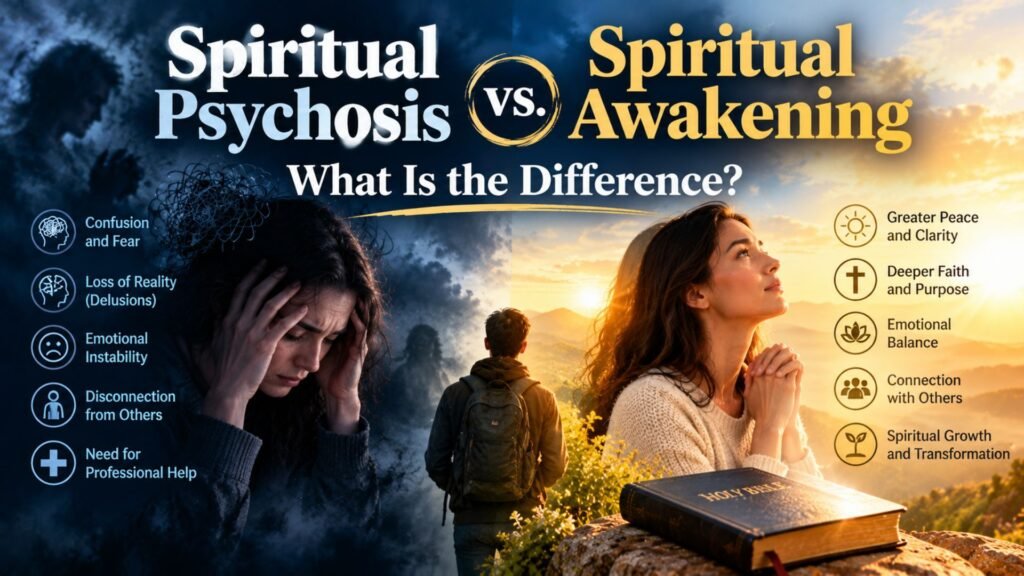
Many people want to know the difference between spiritual awakening and psychosis. Think of a sunrise and a house fire. Both are bright. Only one lets you make breakfast. A spiritual awakening usually brings calm, clarity and kindness. The person keeps working, eating and sleeping. In spiritual awakening vs psychosis, the key clues are fear, confusion and a drop in function. Psychosis often brings terror, strange beliefs and little sleep. The person may not see that anything is wrong. Doctors call this lack of insight.
The same logic answers the difference between a spiritual crisis and psychosis. A spiritual crisis can be painful. The person may doubt their faith or feel lost. Yet they still make sense and stay in touch with reality. In spiritual crisis vs psychosis, the crisis keeps reality testing intact. Psychosis breaks it. Still, a crisis can tip into psychosis when sleep loss and stress pile up. So a professional should assess any unclear case. Culture also matters. When you ask how to distinguish religious beliefs from delusions, look at context. A belief shared by a faith community is not automatically a delusion. A clinician checks distress, function and cultural fit together.
| Feature | Spiritual Awakening | Spiritual Crisis | Psychosis |
| Mood | Calm, peaceful, hopeful | Anxious, sad, doubtful | Frightened, elated or irritable |
| Sleep | Mostly normal | Somewhat disturbed | Severe loss of sleep |
| Thinking | Clear and focused | Questioning but logical | Confused or disorganized |
| Reality testing | Intact | Intact | Impaired |
| Daily functioning | Stable or better | Strained | Clearly disrupted |
| Insight | Present | Present | Often absent |
Case study (a composite example, not a real patient). Daniel attends a quiet retreat. He sleeps well and feels grateful. He goes back to work and calls his mother more often. That fits a spiritual awakening. Maya has a different story. She sleeps two hours a night for ten days. She hears a voice that tells her she must warn the city. She stops answering calls and misses work. Her family sees fear in her eyes. Maya needs a medical evaluation soon.
Signs and Symptoms of Spiritual Psychosis
The signs of spiritual psychosis vary from person to person. One sign alone does not prove anything. A cluster of signs that lasts and disrupts life is the real warning. Doctors group these symptoms of spiritual psychosis into thinking, behavior, sleep and mood. You can use the groups below as a map. The symptoms of religious psychosis mirror those of other psychotic states. Only the spiritual content differs.
Learning the common signs of religious psychosis helps you act early. It also helps you learn how to recognize religious delusions. Look for beliefs that are fixed and extreme. They stay firm even when family and clergy gently disagree. Watch for changes from the person’s normal self. Someone who was calm may turn fearful. Someone who was social may vanish from view. Notice what the belief does to daily life. If it blocks sleep, work and safety, take it seriously.
| Symptom Group | What You May See |
| Perception | Voices, visions, a sense of unseen presences |
| Beliefs | Special mission, divine powers, spiritual persecution |
| Thinking | Jumbled ideas, racing thoughts, odd speech |
| Behavior | Nonstop prayer, fasting, isolation |
| Body and sleep | Little sleep, restlessness, pacing |
Hallucinations and Delusions
People with this condition may have auditory hallucinations and visual hallucinations. Some report hearing divine voices. Others describe seeing religious figures in a room. You may hear it phrased as hearing voices of God or divine beings or seeing supernatural or religious figures. People often ask why people experience religious hallucinations. The brain generates the experience. The person’s faith and culture then supply the story. A Christian may hear an angel. A Muslim may hear a call from a prophet.
A person raised in another tradition may see a different guide. Religious delusions take several forms. Grandiose delusions make the person feel unusually important. Delusions of divine powers convince them they can heal or control events. Persecutory delusions make them feel hunted by demons or dark forces. Many cling to a belief in a special spiritual mission. Some believe you are a prophet or chosen person. Others are believing you have divine powers. These beliefs feel completely real to the person.
Disorganized Thinking and Speech
Disorganized thinking makes ideas hard to follow. The person may jump from one thought to another with no link. Doctors call this flight of ideas when the jumps are fast. Racing thoughts can feel like a runaway train. Tangential thinking means the person drifts away from the point and never returns. Thought blocking means the mind goes suddenly blank mid-sentence. Together these patterns are called formal thought disorder. You might notice disorganized thoughts and religious speech. The person may speak in scripture and symbols that others cannot follow. The words sound meaningful to them. Listeners feel lost. Do not argue over the content. Pay attention to how hard the conversation has become.
Changes in Behavior and Social Interaction
Behavioral changes often show up before anything else. The person may spend hours in excessive prayer. Some begin extreme fasting and lose weight fast. Experts describe excessive praying and fasting as behavioral changes when they take over the day. Social withdrawal follows. The person stops seeing friends and avoids worship groups. Some feel nobody can understand them. Others fear that people are enemies. They may also dress or act like a saint or prophet. Family members often notice these shifts first.
Intense Preoccupation With Spiritual Beliefs
Spiritual preoccupation means the person thinks about little else. Every song, license plate or stranger becomes a sign. The person decodes hidden messages all day. Work and family fall away. A healthy believer can set the topic aside and enjoy a meal. A person in psychosis cannot. The belief dominates every hour and drives risky choices.
Sleep Disturbances and Insomnia
Insomnia and psychosis feed each other. Poor sleep can trigger or worsen psychotic symptoms. Psychosis then makes sleep even harder. A person may stay up all night to fight a “spiritual battle.” After several days without rest, thinking gets worse. Sleep loss is one of the most useful early clues. If a person sleeps very little and feels full of energy, seek help.
Emotional or Physical Agitation
Physical agitation shows up as pacing, shaking or an inability to sit still. Some people repeat ritual movements for hours. Others burst into tears or anger. These moods show weak emotional regulation. Fear and awe can switch quickly. Stay calm around an agitated person. Keep your voice low and give them space. If they seem unsafe, call 988 or 911.
What Causes Spiritual Psychosis?
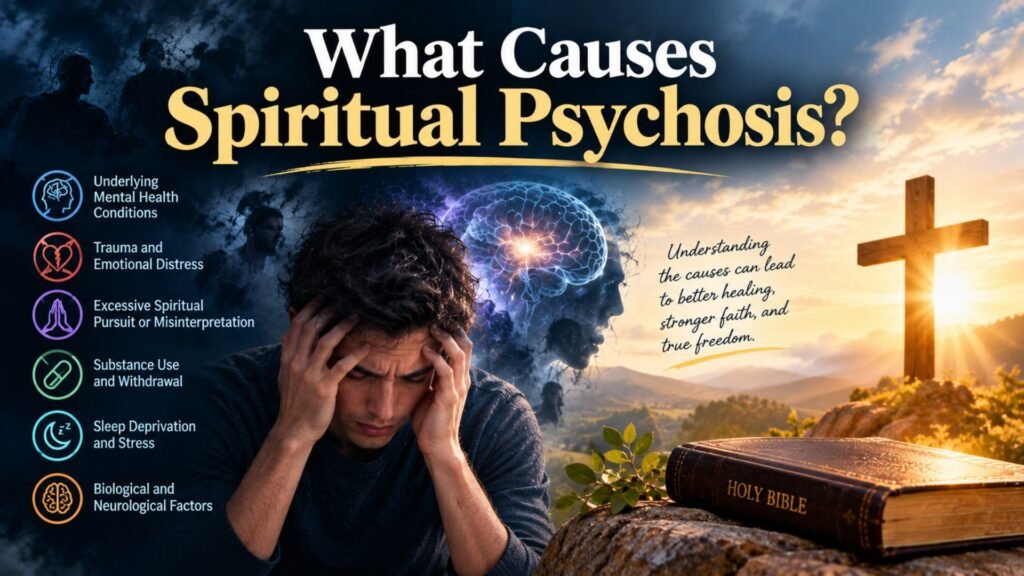
Many readers ask about the causes of spiritual psychosis. The honest answer is that no single cause exists. NIMH puts it simply.
“There is no one cause of psychosis.” (NIMH)
Researchers point to a mix of genetic risk, brain development differences and exposure to stressors. Sleep loss, general medical conditions, some prescription drugs and substance misuse can also cause psychosis. A doctor must rule these out.
Next comes a common worry. People ask can religious experiences trigger psychosis. Faith alone does not cause it. Still, intense practices may add stress in a vulnerable person. People also ask can spiritual practices contribute to psychotic symptoms. Long fasts and days without sleep can push a fragile mind over the edge. So can heavy drug use during a spiritual search. The practice acts as a trigger. The vulnerability sits underneath.
| Cause Type | Examples |
| Mental health | Bipolar disorder, schizophrenia spectrum disorders |
| Biological | Family history, brain chemistry, infection, thyroid problems |
| Life stress | Grief, trauma, major life change, sleep loss |
| Substances | Cannabis, hallucinogens, stimulants, alcohol withdrawal |
| Cultural | Group pressure, stigma, strong spiritual expectations |
Mental Health and Psychological Factors
Schizophrenia spectrum disorders often include religious themes. This is the relationship between schizophrenia and religious psychosis. Religious content is common in some cultures and in some patients. The relationship between bipolar disorder and psychosis matters too.
Bipolar disorder and psychosis can overlap during severe mania. A person in mania may sleep little and feel chosen by God. Depression with psychotic features can bring guilt about sin. Psychological stress and religious psychosis often travel together. A past psychotic episode raises the chance of another. This is why doctors ask about the full mental health history.
Biological and Genetic Factors
A family history raises risk. Doctors call this genetic predisposition to psychosis. The genetic risk factors for psychosis involve many genes. No single gene causes it. Experts also study neurochemical imbalances. Dopamine and serotonin help guide perception and mood. Changes in these brain messengers may play a role. The “chemical imbalance” idea is too simple though. The real picture involves networks and development. Genes load the gun. Stress and sleep loss may pull the trigger.
Stressful Life Experiences
Psychological stressors can tip a vulnerable mind. Job loss, a breakup or a move can do it. Traumatic life events carry even more weight. A death in the family or abuse can leave deep marks. Researchers study trauma and psychotic episodes closely. Grief often sends people searching for meaning. That search can become intense. If sleep and food fall away, risk goes up.
Cultural and Social Influences
Cultural influences on psychosis shape how symptoms look and how people explain them. The cultural and social influences on psychosis also include community response. In some groups, hearing a divine voice is respected and normal. In others, it brings shame. A tight spiritual group may push members toward extreme practice. Stigma may keep a person from care. A good clinician asks about culture early. That step prevents both overdiagnosis and neglect.
How Spiritual Psychosis Can Affect Daily Life
Psychosis takes a toll on daily functioning. Many ask how psychosis affects work and relationships. The answer is wide-ranging. A person may miss shifts or drop out of school. Money choices can turn reckless. A parent may forget meals for their children. Friends feel confused and hurt. Marriages suffer when one partner believes things the other cannot share. Driving and basic self-care may also slip. The illness hits quietly at first and then all at once.
Case study (a composite example, not a real patient). Marcus is a 24-year-old warehouse worker. After his grandfather dies he fasts for days. He stops sleeping. He tells coworkers God has chosen him to expose a plot. His boss sends him home. His sister takes him to a clinic. A doctor starts a mental health assessment. Marcus enters care within weeks. That fast action matters. NIMH notes that people often live with symptoms for over a year before treatment. Earlier treatment usually leads to better recovery. Marcus returns to work in a few months. Waiting often costs more than acting.
How Is Spiritual Psychosis Diagnosed?
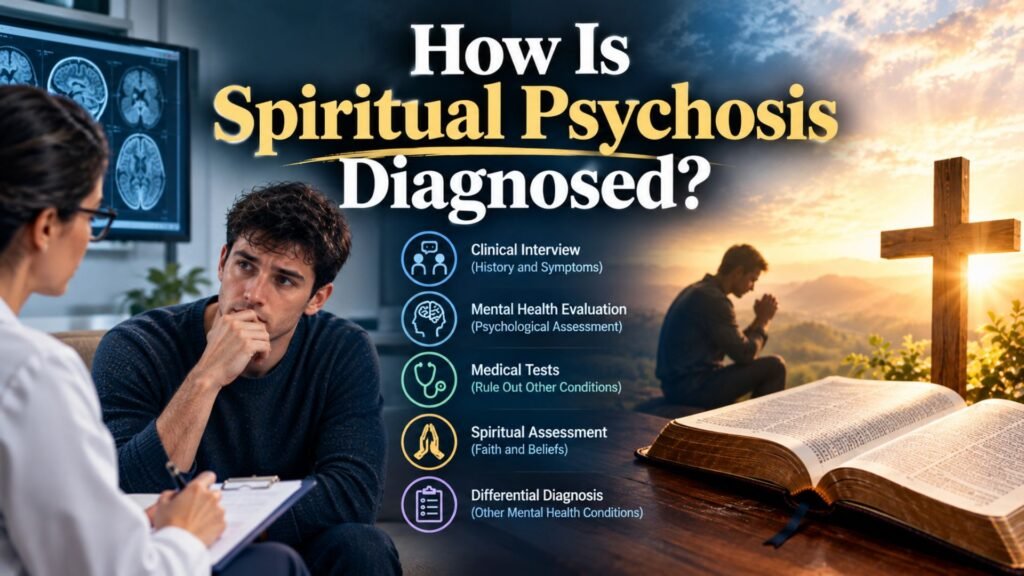
Families often ask how religious psychosis is diagnosed. No blood test confirms it. A psychiatrist, psychologist or other qualified clinician does the work. They hold a long interview and review history. They ask about sleep, drugs, mood and family. They also run lab tests and a medication review. This rules out medical causes. A mental health assessment also looks at risk of harm. The same steps apply to a mental health assessment for psychotic symptoms of any kind.
Culture shapes the process. Clinicians may use the Cultural Formulation Interview to learn about a patient’s background. The DSM also lists a code for a “Religious or Spiritual Problem.” The code was recently expanded to include moral problems. It covers distress that is not a mental disorder by itself. Clinicians use spiritual experiences and reality testing to separate normal experiences from psychosis. You cannot diagnose this yourself. Do not diagnose a loved one either. Book a professional visit. The NIMH Find Help page can point you to services.
Treatment Options for Spiritual Psychosis
Good news comes first. Many people ask can religious psychosis be treated successfully. Yes it can. Doctors tailor care to the cause. Substance-related or medical psychosis often fades when the cause is treated. Psychosis linked to a mental illness usually needs medication and therapy. The main treatment options for spiritual psychosis match those for other psychosis. The topic of spiritual psychosis treatment sounds new. Yet the tools are well tested. Families often ask about psychotherapy and medication for psychosis. Most plans use both. This is evidence-based treatment.
Team care works best for early cases. Coordinated specialty care is now the standard of care for early psychosis. The NIMH RAISE study enrolled 404 people with first episode psychosis. Those in team-based care stayed in treatment longer and improved more. Read the NIMH RAISE results to learn more. These religious psychosis treatment options work whatever the faith of the patient.
| Treatment | What It Does | Typical Setting |
| Antipsychotic medication | Reduces voices and false beliefs | Prescriber visits |
| CBT and other therapy | Builds coping and challenges fears | Weekly sessions |
| Coordinated specialty care | Team plan with family and work support | Early psychosis clinics |
| Family and peer support | Lowers stress and boosts recovery | Groups, home |
| Lifestyle care | Improves sleep and mood | Daily routines |
Psychotherapy and Professional Counseling
Psychotherapy for psychosis helps people make sense of strange experiences. Cognitive behavioral therapy (CBT) is the best studied option. Clinicians use cognitive behavioral therapy for religious psychosis to test beliefs and lower fear. A therapist works gently. They respect the person’s faith. They help the person weigh evidence. Dialectical behavior therapy (DBT) may help with emotional regulation and distress.
Eye movement desensitization and reprocessing (EMDR) may help when trauma lies behind the episode. A clinician decides when each therapy is safe. Trauma work usually waits until symptoms are stable. Many therapists also invite a trusted faith leader into the plan when the patient wants that.
Medication for Psychotic Symptoms
Antipsychotic medication often calms hallucinations and delusions. Many ask are antipsychotic medications effective for psychosis. For most people they help. They work best alongside therapy and support. Different drugs have different side effects. A prescriber adjusts the type and dose with the patient. Stopping a drug suddenly can bring symptoms back. Always talk to the prescriber first. NIMH says treatment lowers the risk of violence and suicide.
Community and Social Support
The importance of family and community support is huge. Family support gives structure and warmth. Community support systems include peer groups, clinics and faith communities. Care can happen at different levels. Outpatient psychiatric care suits stable patients. Residential mental health treatment helps when daily life is unsafe. Early intervention for psychosis programs offer a team in one place. NIMH says its network links to over 100 such programs in 17 states. Ask your doctor about local options.
Mindfulness and Other Complementary Practices
Many wonder how mindfulness supports mental health. Gentle mindfulness builds calm and grounding. Meditation can help too but needs care. Long, intense sessions may worsen symptoms during active psychosis. Ask the care team before starting. Yoga and physical exercise lift mood and improve sleep. Stress management tools like slow breathing also help. These lifestyle changes support treatment and never replace it. Doctors share lifestyle changes for psychosis recovery as part of a full plan. These include steady sleep, regular meals, less alcohol and no street drugs.
Read More About: Spiritual and Biblical Meanings of Dreams About Teeth Falling Out
How Can Loved Ones Support Someone Experiencing Psychosis?
Many readers ask how to help someone experiencing religious psychosis. Start by staying calm. Listen without arguing about the belief. You can say, “I can see you feel scared.” That is true and kind. Then focus on practical needs like sleep, food and safety. Offer to go to appointments. Learning how loved ones can support recovery takes patience. Small steady steps matter more than big speeches. NAMI offers a guide for psychosis-related crises.
Culturally sensitive mental health care also matters. Ask the care team to respect the family’s faith. Many programs welcome chaplains or imams as partners. This is culturally sensitive treatment for religious psychosis. It builds trust and keeps people in care. Take care of yourself too. Caregivers burn out. Join a family group and rest when you can.
| Do | Don’t |
| Stay calm and speak slowly | Mock or shame the belief |
| Say you care and want to help | Argue about proof |
| Encourage sleep and meals | Join in the delusion |
| Ask about safety directly | Leave a risky person alone |
| Offer to attend a visit | Threaten or force |
When Should You Seek Professional Help?
Knowing when to seek professional mental health care can save a life. Seek help soon if symptoms last more than a few days. Do the same for little sleep, strange beliefs or hearing voices. Also act if work, school or self-care falls apart. Early intervention and psychosis management can change the whole path. Dr. John Kane, who led the RAISE study, urged care that starts
“as soon as possible after psychotic symptoms begin.” (Dr. John Kane, News-Medical)
Some signs mean act now. Call or text 988 for thoughts of suicide or serious confusion. Call 911 if anyone is in immediate danger. NAMI notes that 988 reaches a trained crisis worker any time. Be clear about the situation. Say you are calling about a mental health emergency.
FAQs
What is the difference between spiritual psychosis and a spiritual crisis?
A spiritual crisis is painful but keeps contact with reality. Spiritual psychosis involves hallucinations, delusions and loss of insight. A crisis can slide into psychosis if sleep and stress worsen. Any doubt means a clinician should assess.
Can religious beliefs trigger psychosis?
Faith does not cause psychosis. Genes, stress, sleep loss and substances matter most. Religion often shapes the content of the symptoms. Healthy belief and good mental health can coexist.
How is spiritual psychosis diagnosed?
A qualified clinician interviews the person and rules out medical and drug causes. They consider culture and function. See the diagnosis section above for the full steps.
Can spiritual psychosis be treated?
Yes. Medication, therapy and team-based care all help. Early treatment works best. Lifestyle care and family support add strength.
Can someone recover from spiritual psychosis?
Yes. Recovery from religious psychosis is real. Many people ask is recovery from religious psychosis is possible. NIMH says some people never have another episode, while others live full lives even if symptoms return.
Conclusion
Spiritual psychosis is psychosis with spiritual or religious themes. It is not proof of weak faith. The difference between spiritual awakening and psychosis shows up in fear, sleep, reality testing and daily function. Causes include genes, stress, trauma, substances and medical problems. Treatment works. It blends therapy, medication, family support and healthy routines. Most people improve when they get help early.
Approach unusual spiritual experiences with empathy. Do not shame anyone. Hallucinations, delusions, severe confusion or lost function call for a qualified mental health professional. Take one step today. Book an evaluation or call 988 if you feel unsafe. Hope is real. Recovery is possible.