Biblical Meaning of the Name BLAKE: Spiritual Symbolism, Light, and Christian Faith

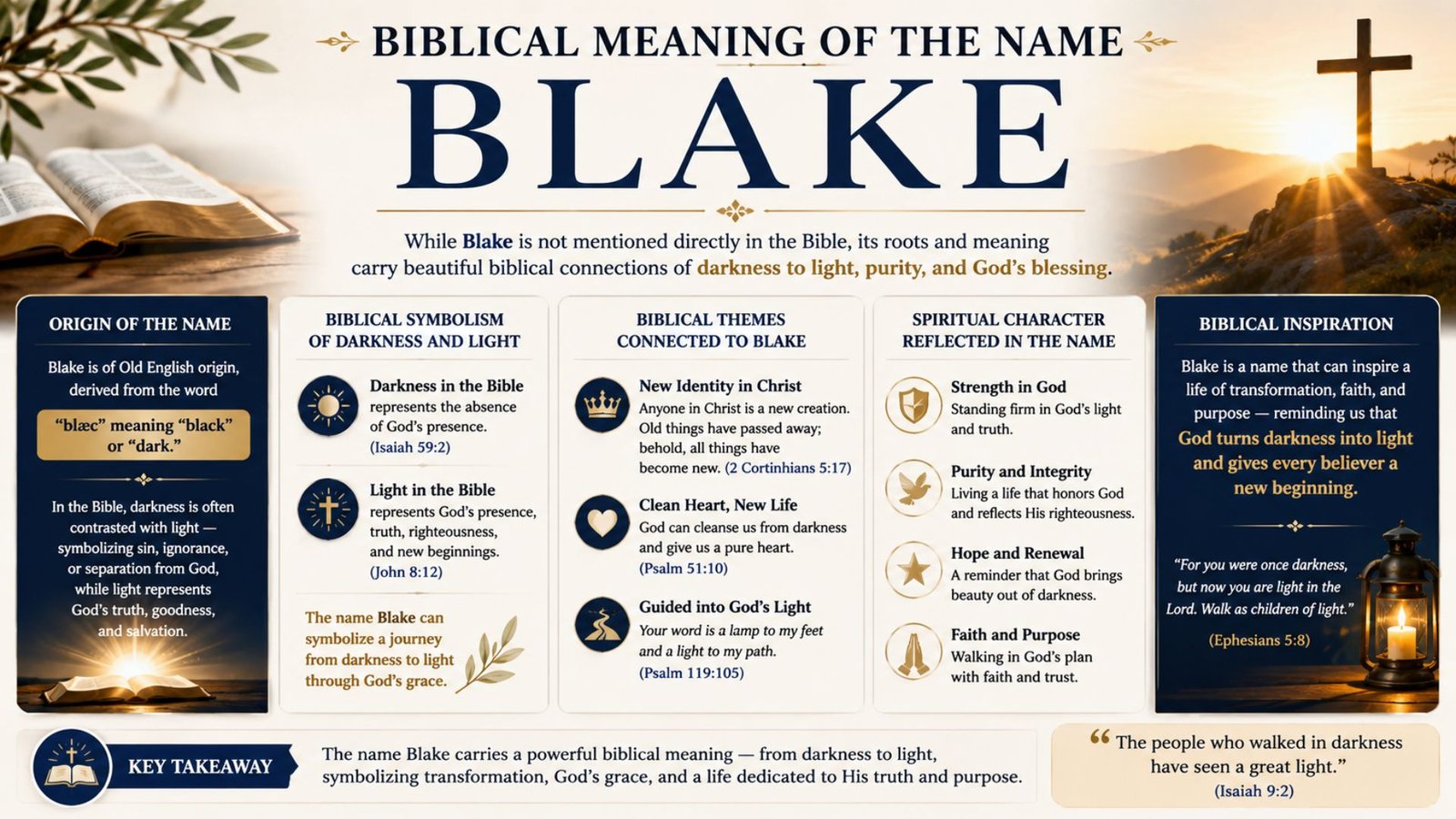
Names carry weight. They shape how we see ourselves, and how others see us too. If you’re searching for the Biblical Meaning of the Name BLAKE, you’ve probably wondered whether this popular name has roots in Scripture, or whether it holds any spiritual weight at all. The short answer? It’s a little of both. Blake isn’t a name you’ll find printed in any translation of the Bible. Yet its story runs deeper than a simple dictionary definition, and it connects to some of the richest biblical themes in all of Scripture.
This article walks through the Blake meaning, its Blake name origin, and the spiritual meaning of Blake that so many parents and believers find compelling. We’ll look at the biblical symbolism of Blake, unpack real Bible verses, and explore how this one small name touches on darkness and light, redemption through Christ, and the everyday work of Christian living. Grab a coffee. This one’s worth reading slowly.
Quick Answer
The Biblical Meaning of the Name BLAKE isn’t found directly in Scripture, since Blake is an Old English name, not a Hebrew or Greek one. Its dual roots, meaning either “dark” or “fair/bright,” connect symbolically to the Bible’s constant theme of light overcoming darkness. Many Christian families see it as a name that quietly points to spiritual transformation and God’s light.
What Does the Name Blake Mean?
Understanding the Biblical Meaning of the Name BLAKE starts with the name itself. The name Blake carries one of the more interesting contradictions in English naming history. Depending on which root you trace, Blake means either “black” or “pale, fair, bright.” Both meanings survived side by side for centuries, and honestly, nobody fully agreed on which one won out.
That contradiction is actually the whole reason people find the Biblical Meaning of the Name BLAKE so compelling. A name that can mean both darkness and light mirrors one of the oldest stories in human experience: the pull between the two. It’s the kind of built-in symbolism a name rarely offers, and it’s why writers, pastors, and parents keep coming back to it.
Origin and Meaning of the Name Blake
A big part of the Biblical Meaning of the Name BLAKE lies in its roots. The Blake name origin traces back to Old English, and specifically to two separate words that just happened to collide over time. One is blæc, meaning “black” or “dark.” The other is blāc, meaning “pale” or “shining.” Over centuries of spoken English, spelling shifted, pronunciation blurred, and both words landed on the same modern form: Blake.
Linguists still debate which root gets more credit. The Old English name Blake likely started as a descriptive nickname, given to someone with dark hair or a pale complexion. It wasn’t picked for spiritual reasons back then. It was practical, almost like a neighborhood label. Only later did people start layering meaning onto it.
Is Blake a Biblical Name?
People asking about the Biblical Meaning of the Name BLAKE often want a direct answer first: no, Blake is not a biblical name in the strict sense. You won’t find it in Genesis, the Psalms, or the Gospels, and no prophet or apostle carried it. It’s an English name through and through, born centuries after the biblical texts were written.
Read More About: Amazing Biblical Meaning of the Name Nicole: Spiritual Symbolism, Faith, and Victory
The History and Cultural Background of Blake
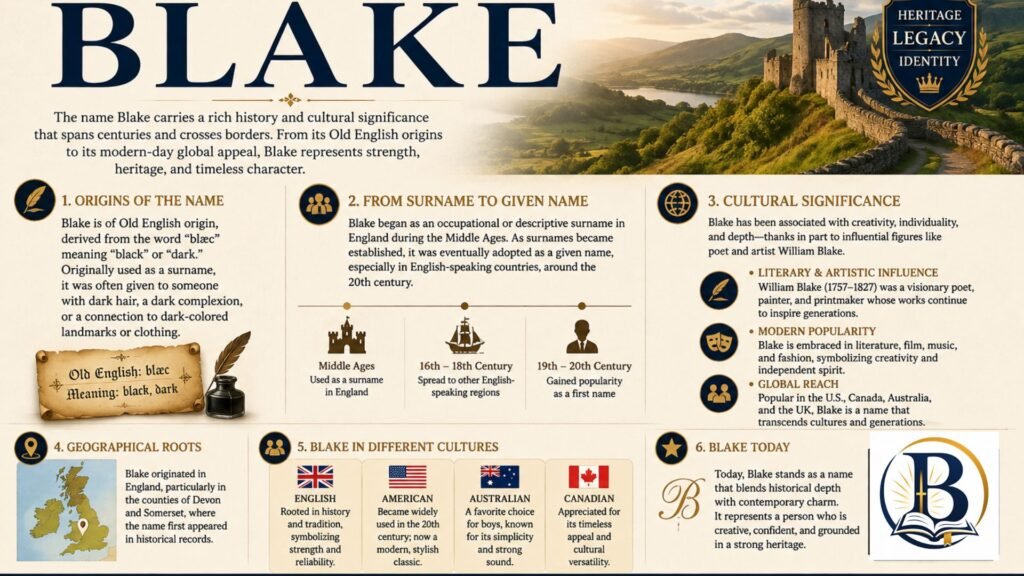
The Biblical Meaning of the Name BLAKE also connects to its long cultural journey. Blake started life as a surname, not a first name at all. Medieval English record-keepers used it to describe people, often based on appearance, sometimes based on where they lived or what they did for work. It sat quietly in surname records for hundreds of years before anyone thought to hand it to a newborn.
Culturally, the name picked up steam in English-speaking countries during the 19th and 20th centuries. Writers like William Blake, the English poet and painter known for deeply spiritual and mystical works, gave the name a kind of literary credibility. By the time American parents started using Blake as a first name in the mid-1900s, it already carried a quiet association with creativity, individuality, and depth.
| Era | How Blake Was Used |
| Medieval England (1000s-1400s) | Surname describing appearance (dark or pale) |
| 1700s-1800s | Occasional given name, gaining literary weight through figures like William Blake |
| 1900s | Crossed into mainstream use as a first name, mostly for boys |
| 2000s-present | Popular unisex name across the US, UK, Canada, and Australia |
How the Name Blake Evolved Over Time
Blake’s shift from surname to first name happened gradually, not overnight. Families in England began using surnames as given names during the 18th and 19th centuries, a trend that helped names like Blake, Taylor, and Mason cross over.
By the late 20th century, Biblical Meaning of the Name BLAKE had shed almost all trace of its surname. It became a standalone first name, popular for both boys and girls, and it kept climbing naming charts well into the 2020s. Actress Blake Lively is one modern example of the name’s unisex flexibility in popular culture.
Blake’s Popularity Among Christian Families
Christian parents often gravitate toward names with symbolic weight, even when the name itself isn’t strictly biblical. Blake fits that pattern well, since its darkness and light contrast mirrors a story many believers hold close to their hearts.
Search data and baby-naming trends from Christian parenting communities show steady interest in names like Blake alongside more overtly biblical-inspired names such as Elijah, Grace, or Noah. It’s proof that faith-based names don’t always need a chapter and verse behind them. Sometimes a name’s deeper symbolism is enough. [Internal link opportunity: link to a related article on choosing biblical baby names for Christian families]
Biblical Themes Connected to the Name Blake
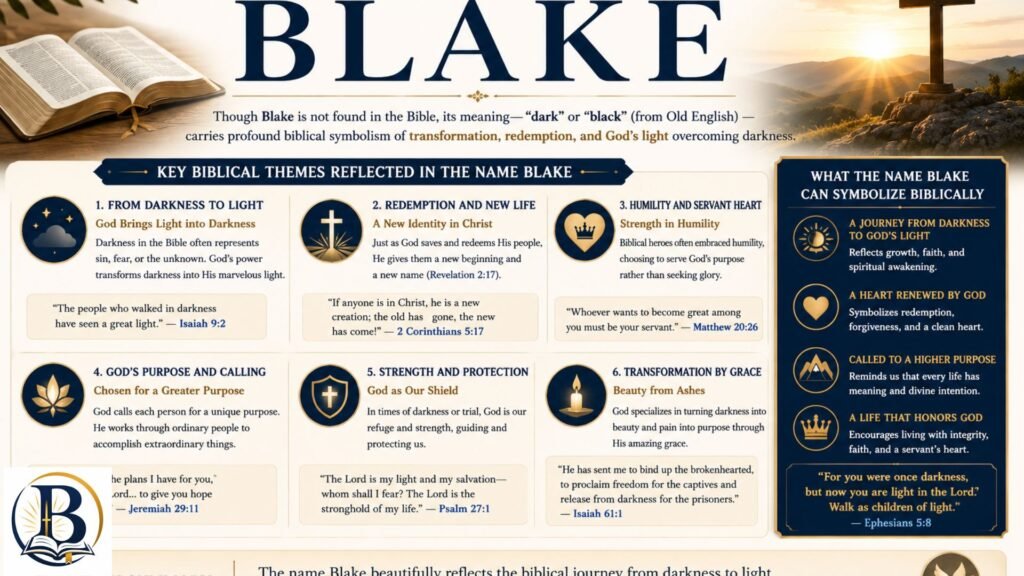
Scripture returns to the image of light and dark more than almost any other metaphor. From the very first chapter of Genesis, where God separates light from darkness, to the closing chapters of Revelation, where there’s no need for sun or moon because God’s glory lights everything, this contrast runs through the entire Bible.
That’s exactly where the Biblical Meaning of the Name BLAKE finds its footing, since the whole idea of the Biblical Meaning of the Name BLAKE rests on this ancient contrast. A name built on the tension between dark and light naturally lines up with one of Christianity’s oldest and richest metaphors. It’s not a coincidence that so many believers feel a pull toward this symbolism when they hear the name.
From Darkness to God’s Light
The Bible describes spiritual darkness as separation from God, and it describes light as His presence, truth, and guidance. Isaiah 9:2 puts it plainly: people walking in darkness have seen a great light. John’s Gospel echoes the same idea, saying the light shines in the darkness, and the darkness has never overcome it (John 1:5).
This is the heart of darkness turned to light, a phrase that captures the whole Christian salvation journey in just a few words. Believers often describe their own faith story this way, a “before” marked by confusion or sin, and an “after” marked by clarity and peace. The name Blake, sitting right at that boundary between dark and light, becomes a small, personal reminder of that bigger story.
Spiritual Transformation Through Faith
Transformation through Christ isn’t a one-time event. It’s a process the Bible calls sanctification, the slow, steady work of becoming more like Jesus over a lifetime. Paul describes it in 2 Corinthians 5:17, saying anyone in Christ becomes a new creation, with old things passing away.
This is a central piece of the Biblical Meaning of the Name BLAKE. That word “new” matters here. Spiritual renewal doesn’t erase your history, but it does redefine your direction. For someone drawn to the spiritual meaning of Blake, this theme offers real encouragement. Growth isn’t instant, and it isn’t always comfortable, but it’s steady. Think of it less like flipping a light switch, and more like a sunrise. Slow, then suddenly bright.
Living as the Light of the World
Although there is no direct Biblical Meaning of the Name BLAKE in Scripture, many people connect the name to biblical themes of light, character, and faithful living. Jesus didn’t speak about light as an abstract idea. In Matthew 5:14, He told His followers, “You are the light of the world.” He then explained that no one lights a lamp only to hide it under a basket. This teaching offers a meaningful spiritual connection to the Biblical Meaning of the Name BLAKE, especially since the name is often associated with the contrast between light and dark.
From this perspective, the Biblical Meaning of the Name BLAKE can symbolize a calling to reflect God’s light through everyday actions. It points to Christian character expressed in ordinary moments—showing kindness at work, practicing patience with difficult people, and choosing honesty even when it comes at a personal cost. Walking in the light means living with integrity in a way that others can see and be inspired by. For those exploring the Biblical Meaning of the Name BLAKE, this biblical teaching provides a powerful spiritual lesson about living as a visible example of faith and goodness.
Hope, Redemption, and New Beginnings
Biblical hope isn’t wishful thinking. It’s confidence rooted in God’s promises, the kind of hope that Romans 5 describes as never putting believers to shame because it’s backed by God’s love. Redemption through Christ takes that hope and makes it concrete: past mistakes don’t get the final word.
The Spiritual Meaning of Blake
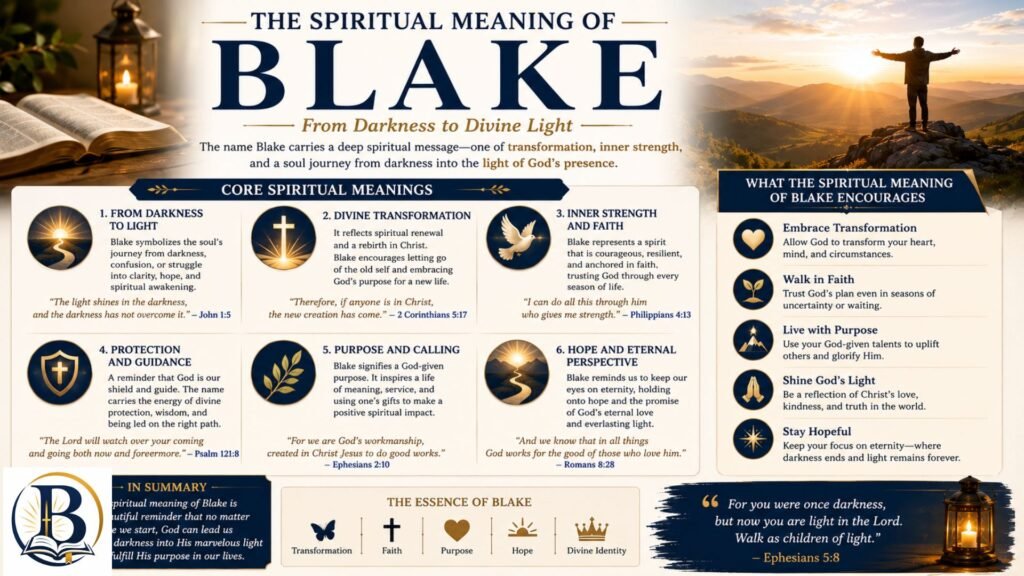
Pulling all these threads together, the Biblical Meaning of the Name BLAKE and the spiritual meaning of Blake centers on contrast and change. It’s a name that holds both shadow and shine at once, which makes it a strangely fitting symbol for the human experience of faith. Nobody moves through life in constant light. Real spiritual growth almost always passes through some darkness first.
That’s not a weakness in the story. It’s the whole point. The Bible doesn’t promise a life free of struggle, it promises a God who meets people in the middle of it. For anyone reflecting on the biblical interpretation of Blake, that honesty is worth holding onto.
Christian Character Reflected in Blake
Christian character isn’t built overnight, and it isn’t built alone either. It grows through perseverance, through humility, through the daily discipline of choosing what’s right even when it’s hard. James 1:2-4 describes trials as something that produce endurance, and endurance as something that eventually produces maturity.
The name Blake, with its built-in tension between dark and light, mirrors that exact process. Biblical virtues like faithfulness and repentance don’t show up as one-time decisions. They show up as habits, repeated choices that slowly shape a person’s identity. That’s Christian identity at its core, not perfection, but persistent direction.
Walking in Faith with Purpose
Divine purpose rarely announces itself with fireworks. More often, it shows up quietly, in small decisions made consistently over months and years. Proverbs 3:5-6 captures this well, urging trust in God rather than leaning on personal understanding alone.
That’s walking in faith with purpose, and it’s a theme that fits naturally alongside the Biblical Meaning of the Name BLAKE. The purpose isn’t about having every answer figured out in advance. It’s about taking the next faithful step, even in uncertain light. Sometimes that’s all faith really asks of anyone.
Bible Verses That Reflect the Meaning of Blake
Scripture offers a handful of verses that speak directly into the Biblical Meaning of the Name BLAKE and the themes wrapped up in this name. Below is a short table summarizing the key passages and how each one connects back to the biblical themes of light and transformation.
| Verse | Core Theme | Connection to Blake |
| Isaiah 9:2 | People in darkness see a great light | Mirrors the dark-to-light contrast in the name’s origin |
| John 1:5 | Light shines in darkness and is never overcome | Reflects hope and resilience |
| Matthew 5:14-16 | Believers are the light of the world | Ties to “the call to shine” |
| 2 Corinthians 5:17 | Anyone in Christ becomes new | Speaks to Christian transformation |
| Ephesians 5:8 | Once darkness, now light in the Lord, so walk as children of light | Direct picture of walking in the light |
| Romans 5:3-5 | Suffering produces endurance, character, and hope | Connects to perseverance and biblical hope |
Each of these passages offers a different angle on the same underlying idea. Darkness doesn’t get the final say in the Christian story. Light does, and that’s a truth worth sitting with, whether or not it’s tied to a name at all.
Personality Traits Commonly Associated with Blake
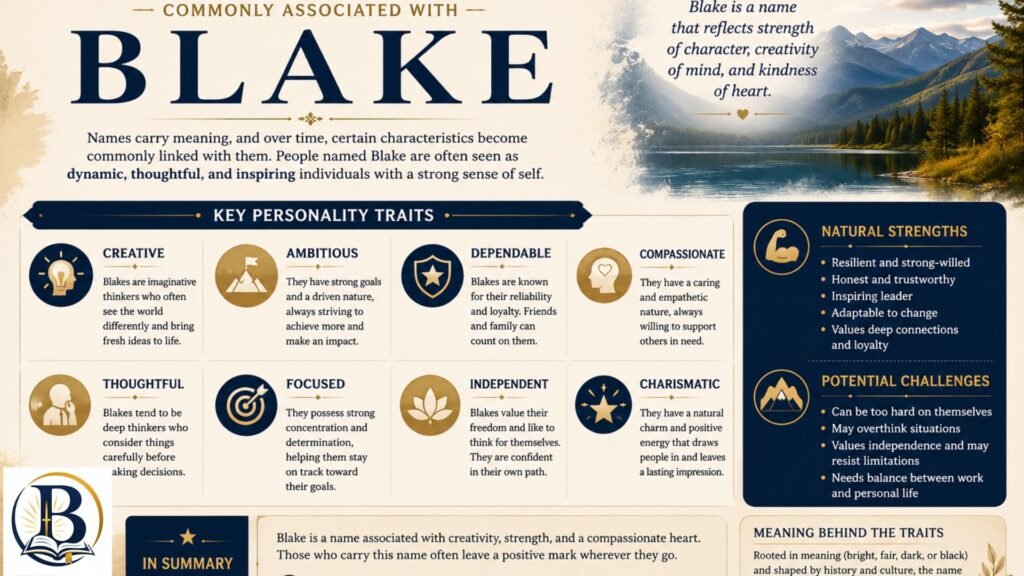
Naming experts and parenting communities often describe people named Blake as strong-willed, creative, and independent. These aren’t scientific facts, more like cultural patterns that show up across surveys and anecdotal parenting forums, but they’re worth mentioning since so many readers search for this angle specifically.
Adaptability comes up often too, likely because the name itself adapts so easily between genders and generations. Resilience is another common thread, which lines up neatly with the spiritual meaning of Blake discussed earlier. A name built on contrast tends to attract people who handle contrast well in real life, or so the pattern suggests. None of this replaces individual characters, of course, but it’s an interesting overlay worth knowing.
Read More About: What is Biblical Meaning of the Name Hailey: Origin & Christian Significance
Frequently Asked Questions
What does the name Blake mean in Christianity?
In Christianity, Blake isn’t a biblical name, but it symbolically reflects the Bible’s theme of light overcoming darkness. Many Christians connect it to spiritual transformation and God’s guidance in the faith journey.
Is Blake a powerful name?
Yes, Blake carries a strong, grounded feel, often linked to traits like resilience and independence. Its dual meaning of dark and light also gives it symbolic depth beyond just sound and style.
What does Blake mean spiritually?
Spiritually, Blake represents the contrast between darkness and light found throughout Scripture. It’s often seen as a quiet reminder of renewal and God’s ongoing work in a believer’s life.
What does the name Blake symbolize?
Blake symbolizes contrast and change, since it comes from Old English words meaning both “dark” and “pale or bright.” That built-in duality makes it a natural symbol for transformation and growth.
What is the Biblical Meaning of the Name BLAKE?
The Biblical Meaning of the Name BLAKE centers on the contrast between darkness and light, even though Blake itself is not a name found in Scripture. It draws its spiritual weight from biblical themes of transformation and God’s light rather than direct textual presence.
What does the name Blake mean spiritually?
Spiritually, Blake reflects the contrast between darkness and light found throughout Scripture. Many Christians see it as a quiet reminder of spiritual transformation and God’s ongoing work of spiritual renewal in a believer’s life.
Conclusion
To sum up the Biblical Meaning of the Name BLAKE: it isn’t about finding a verse with the name printed on the page. It’s about recognizing how a simple Old English word, built on the tension between dark and light, ends up echoing one of the Bible’s oldest and most comforting truths. Darkness doesn’t win. Light, God’s light, always finds a way through. That’s the quiet gift hidden inside this name, whether you’re naming a child, reflecting on your own name, or just curious about where these connections come from.
If you take one thing from this article, let it be this: names don’t have to appear in Scripture to carry spiritual weight. What matters more is the story a name invites you to tell. For Blake, that story is one of contrast, growth, and the steady, patient work of transformation through Christ. It’s a reminder that every season of darkness, whatever shape it takes, is never the final chapter. Light, as the Bible promises again and again, always has the last word.